
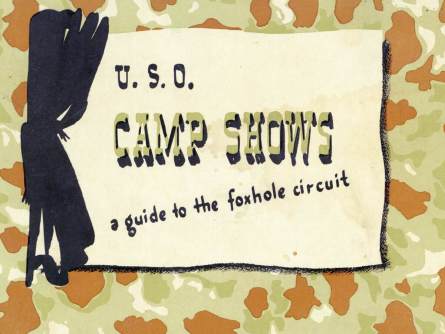
As we all know, it’s a tradition to send celebrities to entertain our troops. I can’t speak to how it would feel to be deployed and suddenly see, say, Robin Williams or Gary Sinise, but I have a slight idea of how it feels to get an unexpected lift when one is exhausted, far from home, and nothing is normal.
Soldiers and sailors have always found ways to entertain each other, generally with games, storytelling and songs. There have also been women and girls called camp followers who provided other forms of entertainment as well. Incidentally, Joan of Arc said her father, Jean d’Arc was initially opposed to her going off to see the Dauphin because he’d had a nightmare about her becoming a camp follower.
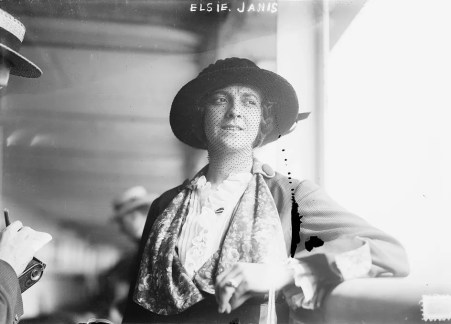
The idea of stars entertaining troops, however, is relatively new, well, if the First World War could be considered new, mainly because acting had only become a mostly acceptable profession in the last decade or so. The queen of overseas performers during the Great War was Elsie Janis. Known as “the Sweetheart of the A.E.F.” Janis was a gifted mimic, she could do cartwheels, she had a deft hand with comedy, she could dance, and she could get a song across, although her musical style was more comedic than pretty.
According to historian, Lee Morrow, Janis was a big sister to the men rather than a sex symbol, and spent the spring and summer of 1918 singing on the back of Army trucks or wherever else she could, bringing the men of the Army Expeditionary Forces a one-woman vaudeville show. For three weeks in the summer of that year, Janis also performed in a Paris hospital for wounded soldiers.
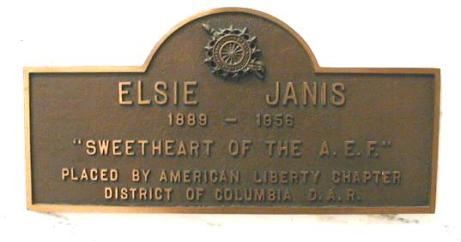
After her shine as a vaudeville performer wore off, Janis wrote screenplays and memoirs and worked as a radio announcer. She even joined Bob Hope on a few occasions when he entertained troops during the Second World War, but after the war Janis lived as a recluse for a decade. Her A.E.F. fellows never forgot her, though, and turned out in force to march in Janis’s funeral procession in 1956, many of them in their uniforms.
During the Second World War, entertainers stepped up to plate in a big way, starting with the founding of the United Service Organization, or USO, on April 17, 1941 at the behest of Franklin Delano Roosevelt. Co-founded by the YMCA, YWCA, the Salvation Army, the National Traveler’s Aid, the National Jewish Welfare Board and the National Catholic Community Service, its aims were not only to provide services to the soldiers, but to raise money for the war effort and give civilians a way to do something for the servicemen.
The USO hit the ground running, establishing canteens and outposts all over the nation and the world, in addition to coordinating tours for troop entertainment. According to the organization’s website, only eight months after the USO was formed, USO Camp Shows, Inc. had to be formed as well because the camp show aspect of their enterprise grew so fast. Not everyone who joined the USO as an entertainer had to be a big name or even an expert at their craft; the soldiers were just happy to be entertained. Between 1941 and 1947, over 7,300 USO performers famous or otherwise, staged over 425,000 shows at an estimated 700 a day.
That’s not to say, of course, that the troops turned their noses up at the bigger names who came through, but they did have certain preferences. Maxene Andrews of the Andrews Sisters noted in her memoir that the soldiers preferred uptempo numbers and nothing too dirty.


Naturally, these tour companies had to get creative and travel light, but it was also important to look one’s best, especially for the women. This was tricky, though, as the performers basically lived as soldiers. John Steinbeck, who was a foreign correspondent for six months during the war, said this in his June 24, 1943 dispatch:
An accordion is the largest piece of property the troupe carries. The evening dresses, crushed in suitcases, must be pressed and kept pretty. Spirits must be high. This is trouping the really hard way.
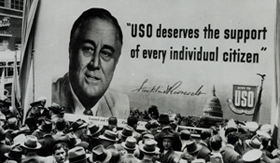
These shows were not without personal risk. Performers and audiences alike were in potential danger, as audiences would sometimes get strafed by enemy fire. Approximately thirty-seven USO performers were killed. Some were taken as prisoners of war. Some had to shelter in basements and foxholes when bombs fell.
Besides the Andrews Sisters, the number of stars who entertained troops at camps and in hospitals is almost dizzying. Judy Garland. Bing Crosby. Ginny Sims. Edward Arnold. Edward G. Robinson. Fred Astaire. Marlene Dietrich. Dinah Shore. Bette Davis. Betty Grable. Joe E. Brown. Dorothy Lamour. Esther Williams. Al Jolson. Lena Horne. Too many to name, really.
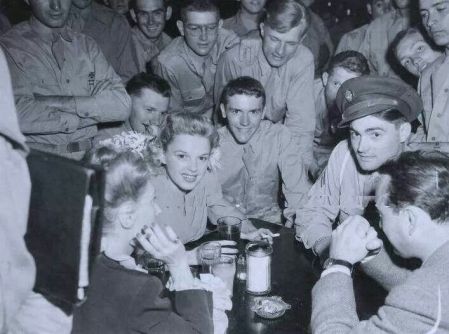
Frances Langford was a huge favorite among the troops as well, with her rich, resonant voice, spunky personality, and fearless attitude. She sang new songs, old ones and everything in between, visiting soldiers as close to the battlefield as she could, often traveling with Bob Hope and Jerry Colonna. Langford’s experiences were related to the public in a syndicated column, which became the basis for the 1951 film, Purple Heart Diary.
Only one camp show tour was immortalized in book and movie form during the war, however. Carole Landis, Mitzi Mayfair, Kay Francis, and Martha Raye toured camps in England, Ireland and Africa for just over three months starting in October of 1942, and Landis recorded their experiences in a book, Four Jills In a Jeep, which was adapted into a movie in 1944. Well, sort of. The film owes very little to the book except for the basic timeline, a few events, and the title. While the book sold well, the film, unfortunately, flopped. It remains a dated novelty piece firmly entrenched in World War Two history, which, personally, is one of the things I like about it. (Read my review here).
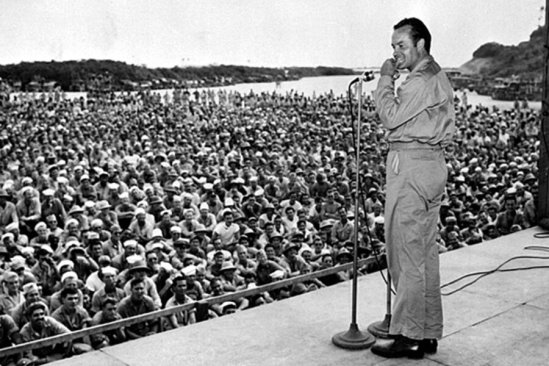
By far, though, no one did more than Bob Hope, who famously and tirelessly entertained troops for over fifty years, starting in August of 1942 until the first Gulf War in 1990. In 1997 he was made an honorary veteran by act of Congress, the only time such a distinction has been conferred on a civilian. Hope also garnered a Presidential Medal of Freedom and a Congressional Gold Medal, was awarded an honorary British knighthood, and won five Academy Awards for his service.
It can’t be underestimated how much good these USO shows did for the troops, and for that matter, still does, as the organization continues to provide help and entertainment for servicepeople and their families. Above all, it brings a bit of the familiar and comforting. As Frances Langford put it, “I’d sing a song, and I could just see the guys getting this faraway expression. I knew they were going home in their minds.”

A very special post is coming up on Thursday. Seriously, all, I’m excited. Have a good one, thanks for reading, and I hope to see you then…
Four Jills In A Jeep is available on DVD from Amazon.
~Purchases made via Amazon Affiliate links found on this site help support Taking Up Room at no extra cost to you.~
If you’re enjoying what you see on Taking Up Room, please subscribe to my Substack page, where you’ll find both free and paid subscriber-only reviews of mostly new and newish movies, documentaries, and shows. I publish every Wednesday and Saturday.
Bibliography
Andrews, Maxene with Bill Gilbert. Over Here, Over There: The Andrews Sisters and the USO Stars In World War II. New York City: Zebra Books, 1993.
 Taking Up Room
Thanks for sharing these insights on the USO tours, and especially the info on Elsie Janis. I hadn’t heard of her before, and I was glad for the introduction!
LikeLiked by 1 person
You’re very welcome, Ruth, and thanks for reading! Elsie was a nice surprise for me, too. 🙂
LikeLiked by 1 person