

Time travel, anyone?
Happy New Year! Pat O’Brien, who was born on November 11, 1899 could always be counted on to play steady, reliable types with no shortage of toughness and bravery, and between 1930 and 1940 he made a staggering sixty-three movies. After Knute Rockne, All American, O’Brien was at loose ends, having left Warner Bros., the studio where he had spent the bulk of the nineteen-thirties, and following fruitless contracts with Twentieth Century Fox and Columbia, O’Brien signed at RKO, where he would take on quite a few military roles. One of these was as an officer in 1943’s Bombardier, a movie that presented the early training of bombardiers with an almost documentary-like realism.
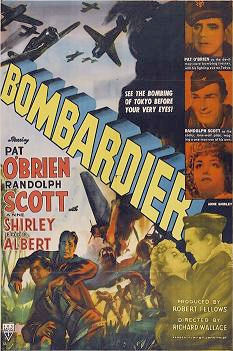
The movie opens at a time just before America entered the war, with Major “Chick” Davis (Pat O’Brien) pitching the idea of high-altitude bombing to the powers that be. It takes a bit of convincing, but a base is installed at the Hughes ranch in New Mexico. A lot of women are already working at the new base, including one of the heirs to the Hughes ranch, Burton Hughes (Anne Shirley), and dozens of eager hopefuls line up to go through the bombardier school. Her brother, Tom (Eddie Albert) is also stationed at the base and learning how to be a bombardier.
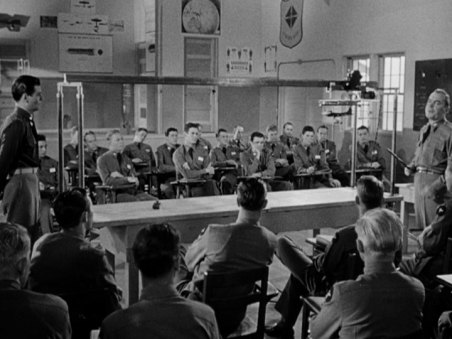
It isn’t easy. The cadets are put through stress tests, flight simulations using plywood targets and wooden bombs with pointed metal on the ends. The real litmus test, though, is when the students are taken up in actual planes to drop fake bombs and maybe try to parachute out of their bombers. Everyone is understandably nervous, but some choke, only to beg for another chance. Others find, whether they like it or not, that they’re better suited to other jobs. Their families don’t always understand what the men are doing or why it’s important, but that gives the film an opportunity to remind the audience that fighting for one’s freedom isn’t a cheap enterprise.
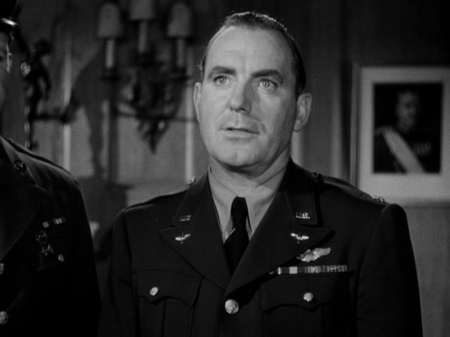
The base is not without its drama and intrigue, mostly centering around Burt, who’s a fixture at the base and works as a secretary to Chick. She knows everything about what goes on and what goes in and out. She’s also got the men dancing attendance on her, particularly Jim (Walter Reed) and the base’s big cheese, Oliver (Randolph Scott). There are also curious people who want to know what’s happening on the base, but that’s taken care of. Chick oversees all of this with a watchful, thoughtful eye, and it’s hinted that he also has feelings for Burt, who has no problem reminding him to shave and be his best self.
All of this happens before Pearl Harbor, after which Chick, Oliver, and the rest of the men are thrust into the action in one way or another, flying to Tokyo to put their training into practice during the summer of 1942. The movie doesn’t shy away from how dangerous the bombardier training was, or what often happened to crews that were shot down, but it also emphasizes the heroism and sacrifice made by these men in what was often a doomed venture.
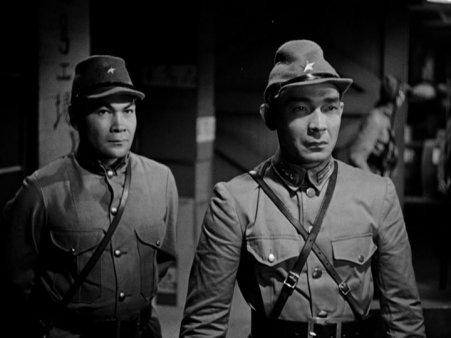
It also presents the Japanese as being really horrible, unreasonable and quite literally subhuman. One of them even hisses at the Americans during the capture scene. It might seem a bit over the top, and not every movie from that time approached the Japanese in this way, but unfortunately the movie came on the heels of the Bataan Death March and other atrocities in the Pacific and many Americans were angry and fearful.
Bombardier is a gripping movie, albeit obvious propaganda. The story is pretty thin, and the characters aren’t drawn as well as they could be, mainly because they are there to showcase the training process, but the acting is superb, especially Randolph Scott and Pat O’Brien, whose characters both look haunted but resolute. Even Burt has a resolute look about her, especially once the cost of what the men are doing hits home for her.
While RKO spared no expense promoting Bombardier, they didn’t kid anyone about the film’s minimal plot or try to play up the romance–it was presented more as a drama centered around the real process of bombardier training. Even so, exhibitors had fun promoting the film, with cities encouraged to stage mock air raids in which bombers dropped bomb-shaped paper leaflets promoting the movie and putting up posters in defense plants (Read about Stanton Theater’s promotion of the film in Philadelphia here).
The film was a great success, bringing in over five million dollars at the box office, or around $163M in today’s money. While it did Pat O’Brien and Randolph Scott favors, it also boosted the prestige of Robert Ryan, who played the incredibly nervous and reluctant cadet Joe Connors. O’Brien was so impressed with Ryan’s work on Bombardier that he asked to work with Ryan on his next movie, jumpstarting what would be a long and respected film career.
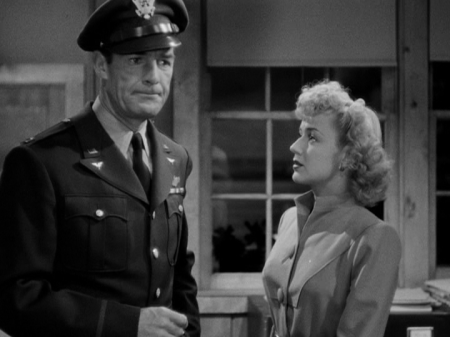
The actors weren’t the only people on the film to benefit, either: Incidentally, the film was edited by Robert Wise, who had also edited Citizen Kane and would, as all film lovers know, go on to be a respected director.
Even though the film was meticulously accurate, there were some differences. It’s not spelled out in the press materials, but my guess is that names of locations or steps of the training process were changed or left out just in case untrustworthy eyes happened to see the film. Media of the time was known to do that for obvious security purposes (see Air Force as another example).
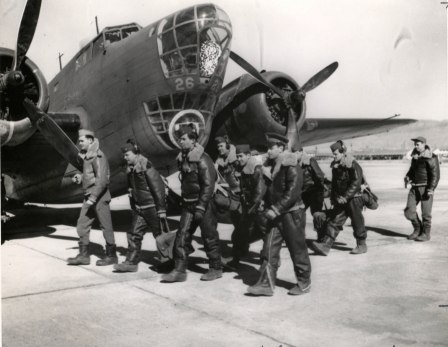
The setting of the film was also changed from where bombardiers were first trained. In real life, the first bombardier training school was established at Lowry Field, Colorado, but Bombardier was shot at Kirtland Field in Alberquerque, New Mexico, which remains an active Air Force Base to this day. During the war, Kirtland trained thousands of bomber and combat personnel, who, according to the Air Force’s website, served in all theaters of the war. Lowry Field, on the other hand, closed in 1994, but many of the original buildings and a few of the hangars are still in use, preserving the base’s history and heritage.
Bombardier‘s story is set so early in the war that the crudeness and sheer experimental nature of early bomber tech is painfully evident, not just in the training methods but in the look of the equipment, and nowhere is this more evident than in the oxygen masks, which are pretty darned weird, like something Groucho Marx would wear. I’ve never seen a design like this in any other wartime movie or in any museum as yet, so these masks must have been chucked pretty quickly. Not only did they look uncomfortable and goofy as all get-out, but heaven forbid anyone hyperventilated in those things at ten thousand feet, because the results would have been disastrous.
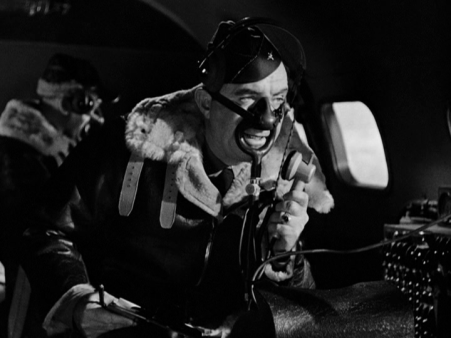
Its primitive quality, though, makes Bombardier an educational and valuable film regardless of who sees it. Audiences during the war would have been educated about a new method of combat, and audiences today can get a glimpse of how crews prepared for some of the most dangerous acts of the Second World War. In that sense, it’s very entertaining even if the story itself is pretty much a footnote.
For more of 1899, please see Erica at Poppity Talks Classic Film. Thanks for hosting this, Erica–what a great way to start the year! Or end it, depending on who posted their posts before the clock struck midnight on the 31st. Anyway, thanks for reading, all, and I hope to see you tomorrow for a new “Stage To Screen.”
Bombardier is available to own on DVD from Amazon.
~Purchases made via Amazon Affiliate links found on this site help support Taking Up Room at no extra cost to you.~
If you’re enjoying what you see on Taking Up Room, please subscribe to my Substack page, where you’ll find both free and paid subscriber-only reviews of mostly new and newish movies, documentaries, and shows. I publish every Wednesday and Saturday.
 Taking Up Room
2 thoughts on “Over the Target”