
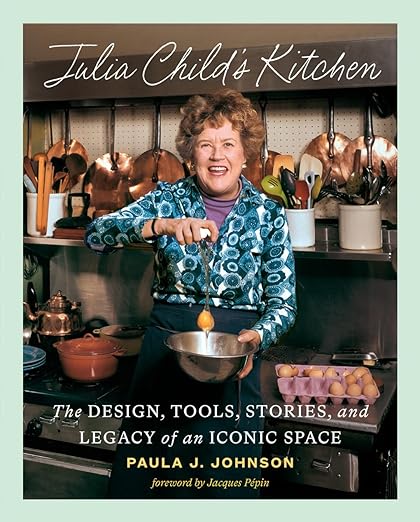
“Julia Child’s kitchen” is a truly magical phrase, right up there with “Aladdin’s cave” or “the lost city of Atlantis.” Or maybe even “Powell’s City of Books,” but I digress.
Anyway, America has plenty of iconic chefs, and after Hannah Glass, Amelia Simmons, and Fannie Farmer, Julia Child is a towering presence in more ways than one. It’s not often that someone’s entire kitchen ends up in the Smithsonian, and in Julia’s case, her kitchen is another character in her story.
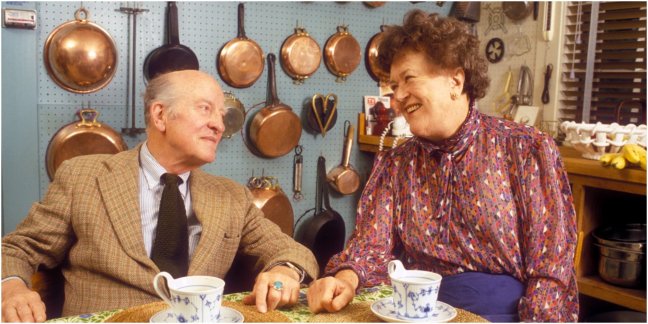
I haven’t been back to the Smithsonian in years, so I haven’t seen Julia’s kitchen exhibit, but I’ve heard that her kitchen had so many objects in it that it’s impossible to display them all at one time. Obviously that means the museum staff have to get creative. The artifacts and many of their stories are also catalogued in Paula J. Johnson’s absolutely fascinating 2024 book, Julia Child’s Kitchen: The Design, Tools, Stories, and Legacy of an Iconic Space.
Julia Child’s Kitchen takes an object by object, angle by angle approach to Julia’s workspace. Every wall is examined, even the floor, and nothing goes unnoticed. Even the art on the walls, including Julia’s famous wooden cat cutout, and the Rubik’s Cube next to the phone get mentions.


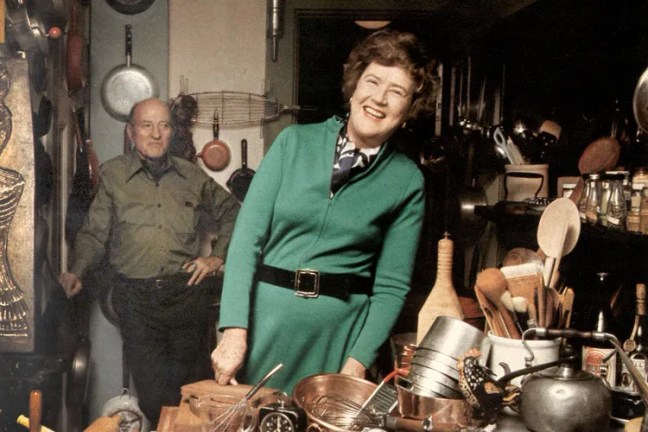
Julia’s kitchen is almost a museum in and of itself, because it spans not only Julia and Paul Child’s personal history, but the history of modern culinary methods. The kitchen has so many gadgets and utensils and tchotchkes that it’s amazing it stayed as neat as it did. Well, neatly cluttered, anyway. The counters, were, of course, raised to thirty-eight inches to accomodate Julia’s commanding height.
We get to see Julia’s famous mortar and pestle, but we also see her food processors and food mills, of which she had multiples. There are knives everywhere because Julia was a self-professed knife aficionado, as well as pans, pans, pans. It wasn’t so much that Julia was materialistic, but as a public figure and the patron saint of American French cooking, Julia felt people were looking to her to tell them what she thought of newfangled gadgets, and she happily obliged.
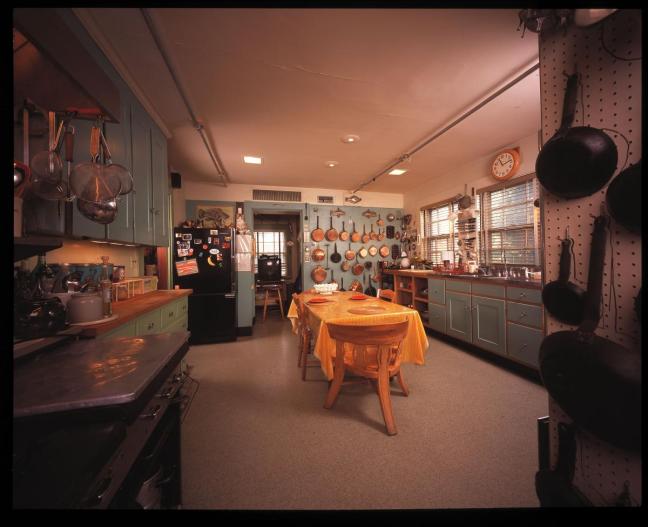
Here’s the thing about Julia’s kitchen, and for that matter, her house that a lot of people don’t know about, at least not readily: The house actually had two kitchens. One was, of course, the big famous showroom, while the other smaller kitchen was in the basement and mostly used for prep. I can’t imagine carrying prepped food up basement stairs, especially raw meat, but the Childs and their guests obviously made it work.
And yes, guests cooked in that kitchen. Julia and Paul set it up so efficiently that even someone who had never been to the Child house before would know where to find the eggs and bacon to start breakfast. It was also, of course, where many of Julia’s television shows were filmed with various chefs, among them one of my other favorites, Jacques Pepin, who wrote the forward for Julia Child’s Kitchen.

Julia and Jacques were and are priceless. I don’t know about anyone else, but in my opinion the chemistry and banter between these two, as well as the food they turned out together, comprise some of the best moments in culinary history. Like Fred Astaire and Ginger Rogers or Judy Garland and Mickey Rooney. We’ll never see the like again, and more’s the pity.
When Julia donated her kitchen to the Smithsonian in 2001 before moving to a care home in Pasadena, it was a bittersweet process. Dismantling the kitchen was, of course, done very slowly and thoughtfully, with lots of stories and good food punctuating the whole enterprise. In a rather morose twist of fate, the 9-11 attacks happened in the midst of it, which upset everyone on the project, but the ever-steady Julia encouraged them to carry on even if what they were doing now felt strange and surreal.
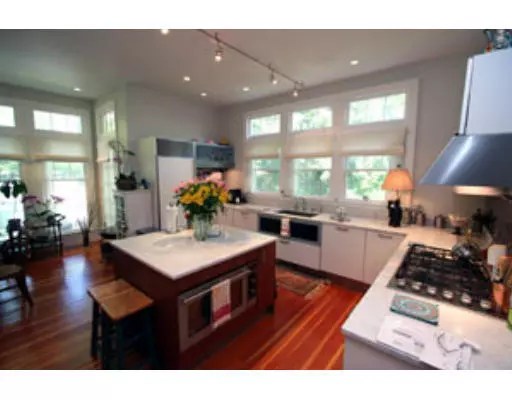
What must have been equally surreal was the empty shell where Julia’s kitchen had been. Julia bequeathed her house to her alma mater, Smith College, which later sold it. Currently the house is a private residence, with the kitchen remodeled beyond recognition and the house’s current value being roughly seven million dollars. It looks nice, but there’s nothing whatsoever to indicate that Julia Child once cooked there. No telling if the prep kitchen downstairs still exists, but either way, I have to wonder how conscious the current owners are of the history of that house.
Julia’s kitchen is currently part of the Smithsonian’s FOOD Exhibit, and like anything else, has been subject to wear and tear despite being in repose. Anyone who goes into the kitchen has to wear booties because the floor is a paper reproduction of the original linoleum.
It’s safe to say that, like the Ruby Slippers, it’s going to be a fixture at the National Museum of American History for many years (Read my friend and fellow Julia fan John Reiber’s blog post about the kitchen here. He’s got some great stories.). For those who can’t get to Washington, D.C. or who might want to relive looking at the exhibit, Julia Child’s Kitchen is a treasure.
Another post is coming out on Tuesday. Thanks for reading, all, and have a good one…
~Purchases made via Amazon Affiliate links found on this site help support Taking Up Room at no extra cost to you.~
If you’re enjoying what you see on Taking Up Room, please subscribe to my Substack page, where you’ll find both free and paid subscriber-only reviews of mostly new and newish movies, documentaries, and shows. I publish every Wednesday and Saturday. You can also subscribe to my Club 15 Tier, which gives you at least one extra Taking Up Room post every month for a small fee.
 Taking Up Room