

Here we go…
For all the movies and documentaries that had been made about the Titanic sinking from the time that it happened, until 1996 one very pertinent detail was always left out, and that was the ship breaking in two.
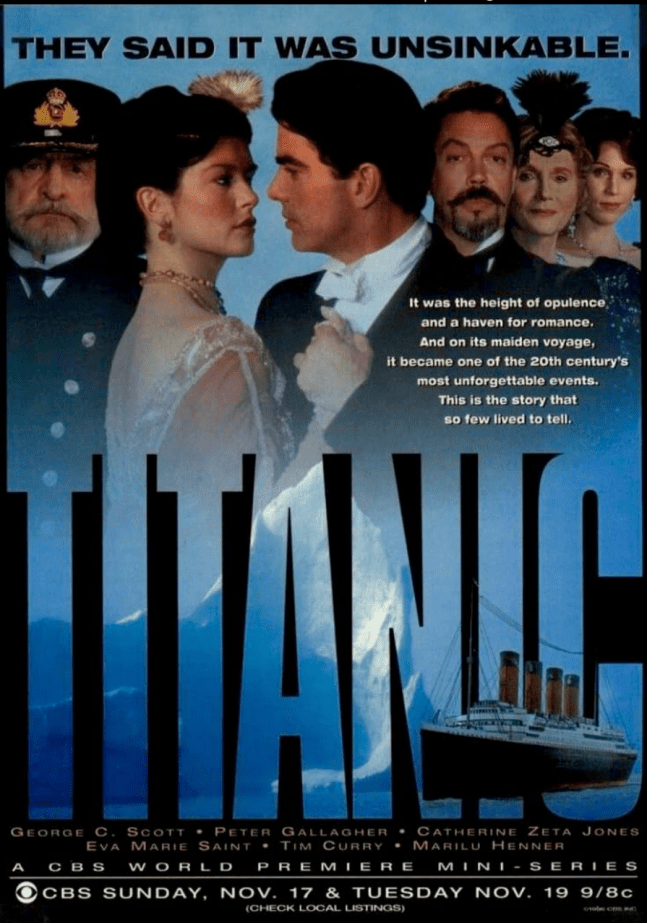
It might sound a little funny now, but up until Dr. Robert Ballard discovered the wreck, every depiction of the Titanic showed the ship sinking in one piece. It didn’t matter if it was A Night To Remember or Night and Ice or the 1953 Barbara Stanwyck film. The ship always went down in one piece, looking relatively neat and orderly, if such a terrible event could ever be neat and orderly, with the ship sliding under the water almost serenely.
Survivors, however, saw it differently. Eva Hart, who was seven at the time, distinctly remembered the ship breaking in two as it sank. Teenager Jack Thayer described what he saw to a man named L.D. Skidman, and Thayer also remembered the Titanic splitting in half, testifying to that fact under oath at one of the inquiries.
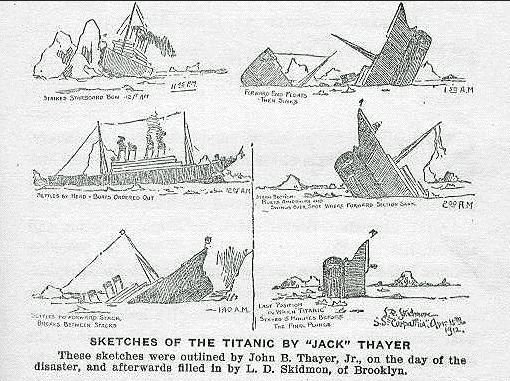
Why was this so important? For some reason at the time of the sinking, there were plenty of people who swore up and down that the ship sank in one piece. Any suggestion otherwise seemed offensive, as if it somehow reflected badly on them that the technology they put so much trust in had failed. Or maybe they just didn’t notice. Second Officer Charles Lightoller couldn’t remember the ship breaking in half, but it’s speculated that he may have been underwater when it happened. The White Star Line’s official story was that the ship sank intact.
It would seem that with so many testimonies to the contrary that the historical record would reflect what the passengers said, but the social hierarchy at the time dictated that the words of a First Class passenger, a ship’s officer or the shipping company automatically carried more weight. Survivors were simply told that they hadn’t seen what they had seen.
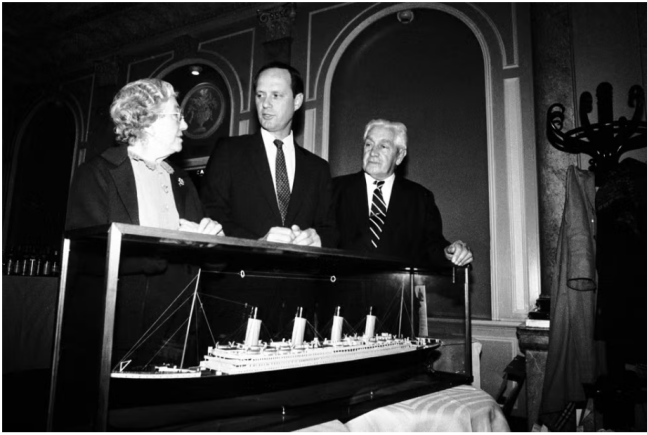
When Dr. Robert Ballard led the expedition that discovered the wreck in 1985, the world rocked back on its collective heels and survivors who were still living were vindicated after over seven decades of gaslighting.
Naturally, Hollywood had to change the way the wreck was portrayed as well, and the first time the Titanic was shown splitting in half on film was in the 1996 miniseries, The Titanic.
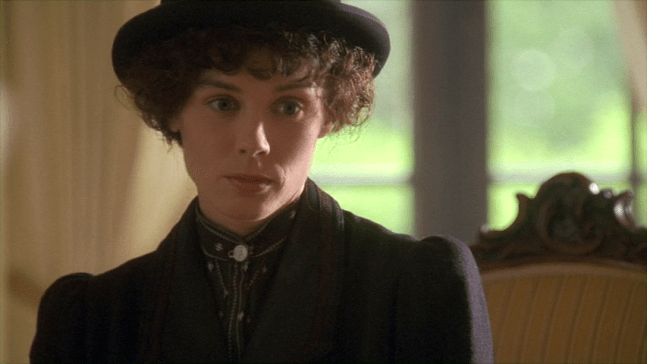
It all starts out with Alice Cleaver (Felicity Waterman) waking up after a nightmare involving a shipwreck and a dead baby. There’s no time to be scared, though, because Alice has a job interview with the Allison family, who are bound for America. Alice is uncomfortable talking about her background, but she gets the job, and the family boards the Titanic.
We see Isabella Paradine (Catherine Zeta-Jones), who’s on her way back to America after the death of her aunt, and she runs into her old flame, Wynn Park (Peter Gallagher). At first Isabella is uncomfortable with Wynn’s stateroom being across the hall from hers, but as she and Wynn talk she succumbs to his charms, and it’s not hard to guess where it all goes. In case things aren’t complicated enough, Isabella’s husband and daughter are waiting for her in New York.
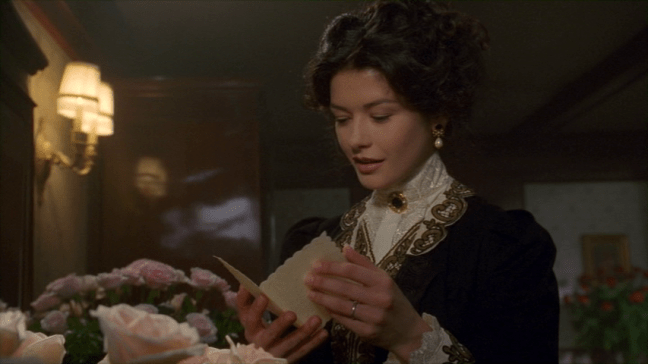
And oh yes, we also see Jamie Perse (Mike Doyle), who steals a ticket from Mr. Dickie (Don McKay), a drunk man in an alley, and boards the Titanic using Mr. Dickie’s name. Jamie has already fallen in with Simon Doonan (Tim Curry), an unsavory type who poses as a crew member so he can sneak into passengers’ rooms and steal them blind.
Jamie’s resolve is tested, however, when he meets Aase Ludvigsen (Sonsee Neu), who is traveling with the Jack family to Minnesota and is a convert to their religion. The series isn’t clear about what religion they are, but since the Jacks are Irish, it might be Catholic. Or Mormon. Who knows?
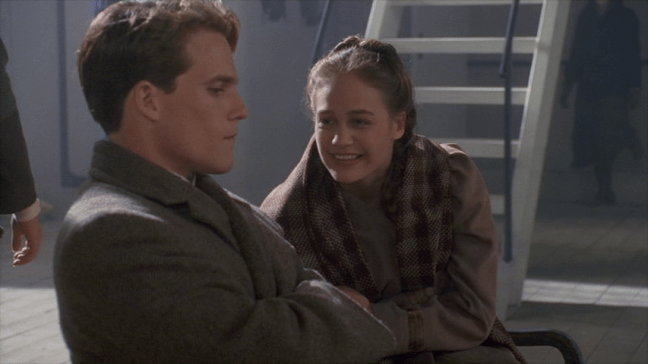
Of course there are some portrayals of actual historical figures, including Captain E.J. Smith (George C. Scott), Molly Brown (Marilu Henner), Harold Bride (Buddy Pepper) and Madeline Astor (Jann Mortil), and everything clicks along for the most part, with everyone having a good time, but of course, it all leads up to the night of the sinking.
Right before that happens, though, Isabella has scruples about her affair and tries sending a telegram to her husband. Jamie has scruples about hanging out with Simon, who is not only a major creeper, but rapes Aase while she takes a shower.
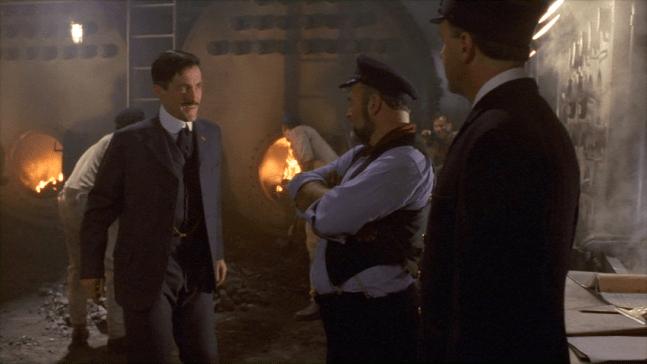
The Allisons, meanwhile, have serious doubts about Alice, who’s neurotic and too harsh with the children, plus the Astors’ maid thinks she’s the Alice Cleaver who murdered her baby. Bruce Ismay (Roger Rees) keeps poking himself where he’s not wanted, and Harold and his co-worker, Jack Phillips (Matt Hill) work through their backlog of messages while telling the wireless operator on the Californian to pipe down.
When it comes to the actual sinking, the miniseries is fairly accurate although not very. We see the women and children put into the lifeboats. We see the Third Class passengers kept downstairs. We see Mrs. Strauss refusing to be separated from her husband. We see Alice making off with Trevor Allison while his parents look for him frantically. We hear the screams. We see the drowned bodies in the water. It’s as graphic as possible for a TV production.
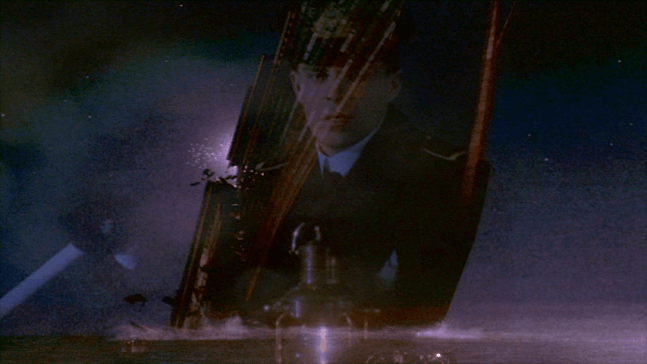
As for the Titanic splitting, though, the film gives the idea of the ship breaking in two, but the emphasis is more on the horror of the event and people’s reactions to it, which are done very effectively. The most we see are objects falling and a bit of deck breaking. It wouldn’t be until the 1997 James Cameron film that we would get a drawn-out depiction of what the sinking probably would have looked like.
The miniseries itself, up until the sinking, is a typical TV miniseries of the 1990s. It looks mostly very clean and tidy. The CGI isn’t the best, but it was 1996, after all. There’s a certain amount of cheese going on, mostly from First Class passenger Mrs. Foley (Eva Marie Saint), who’s such a diva that she sneaks her Volpino Italiano dog onto a lifeboat. Plus, it’s not hard to root for Isabella and Wynn, because Peter Gallagher and Catherine Zeta-Jones have a very steamy chemistry.
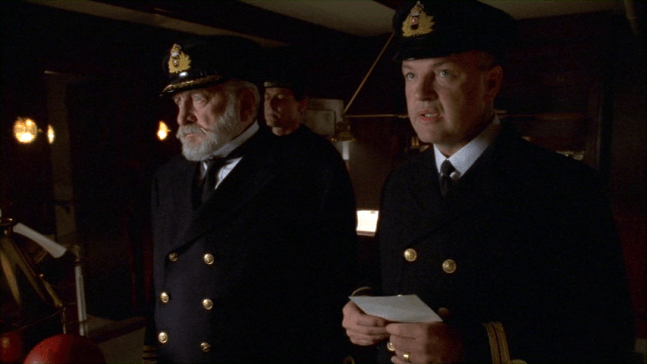
And Tim Curry as Simon Doonan smiles like the Grinch most of the time, especially when he appears to Aanse in the showers. It’s almost too melodramatic. Curry does play a good villain, but he just stops short of twirling his mustache here. His performance still works, though. I hate to say it because we’re talking about a real event, but Simon is the one person who deserved to go down with the ship. Naturally, he sneaks into a lifeboat disguised as a woman and gets knocked overboard, which is a huge relief.
To be sure, there are some inaccuracies. Alice Cleaver is probably the most glaring one, as the Alice Cleaver who sailed on the Titanic is not the same one who murdered her baby. That was Alice Mary Cleaver, who was convicted in 1909 and died of tuberculosis in 1915. Unfortunately for Alice Catherine Cleaver, who went on to marry and live quietly, the two Alices have been conflated in Titanic lore and only just recently seem to have been separated.
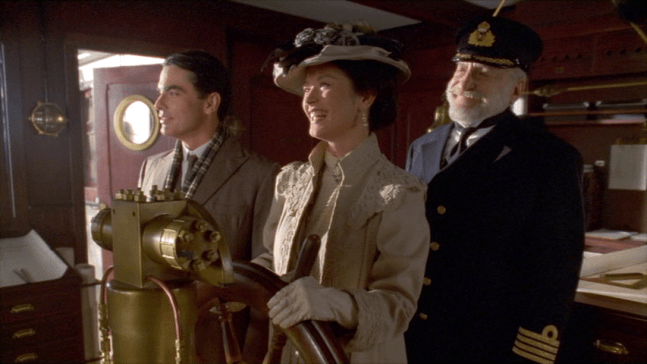
Another thing is that the romance between Isabella and Wynn might not have been a shocker in 1912. That was our modern sensibilities talking. During the Edwardian era, it was not uncommon for people of the upper classes to have affairs. Isabella’s guilt had more to do with her character’s personal moral code and not necessarily the general mores of the time period. It was also expected that men would look after unaccompanied women on sea voyages to protect them (Colonel Archibald Gracie was one such gentleman), so no one would have thought twice about Wynn spending time with Isabella.
Molly Brown is another goof, as the series refers to her as “Molly” and not “Margaret,” which is what she was called when she sailed on the Titanic. Marilu Henner plays a great part, though, and is a huge highlight of the series.
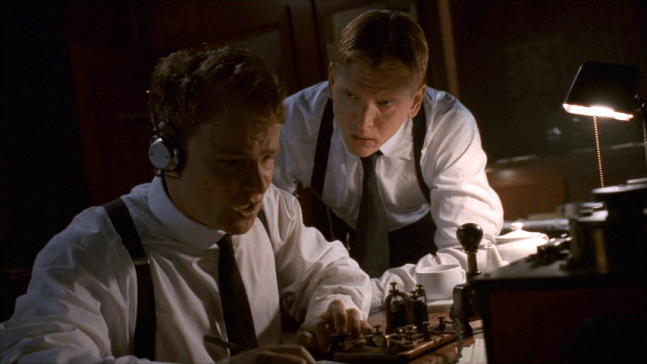
The series was also pretty even-handed with J. Bruce Ismay, and doesn’t try to villify him too much. Other versions, such as the James Cameron film, portray Ismay as a huge pest and a coward, probably for dramatic purposes, plus it’s a fact that Ismay’s reputation never recovered after the sinking. Recent scholarship, however, has cast doubt on how much Ismay was actually at fault when it came to the circumstances surrounding the sinking, but since so much time has passed we may never know for sure.
Like every depiction of the sinking, the 1996 Titanic miniseries makes us wish the outcome had been different, and despite its hiccups, it moves the ship’s cultural narrative along, increasing our horror at a terrible event and daring us to look away.
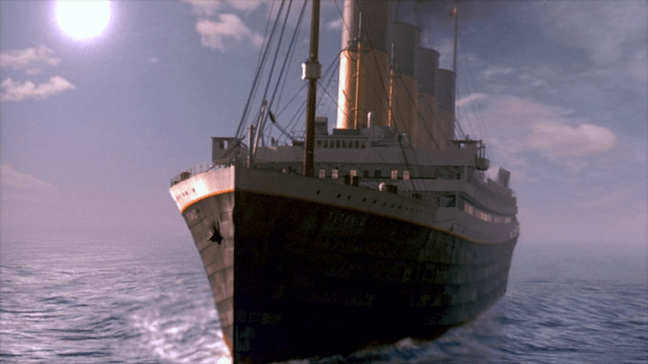
For more of the Titanic in pop culture, here are our Day One, Day Two, and Day Three entries. Thanks for reading, all, and I hope you’re enjoying this blogathon…
The Titanic is available on DVD and Blu-ray from Amazon.
~Purchases made via Amazon Affiliate links found on this site help support Taking Up Room at no extra cost to you.~
If you’re enjoying what you see on Taking Up Room, please subscribe to my Substack page, where you’ll find both free and paid subscriber-only reviews of mostly new and newish movies, documentaries, and shows. I publish every Wednesday and Saturday. You can also subscribe to my Club 15 Tier, which gives you at least one extra Taking Up Room post every month for a small fee.
 Taking Up Room
You had me at George C Scott and Marilu Jenner…
LikeLiked by 1 person
Yeah, they’re really good here. Scott’s part is a little small, but he’s great.
LikeLiked by 1 person
That should say Henner not Jenner.. my phone went crazy.
LikeLiked by 1 person
Ah yeah, that happens. 😊
LikeLiked by 1 person
Frustrating isn’t it…
LikeLiked by 1 person
It really is. Modern technology, right?
LikeLiked by 1 person
It’s fascinating to read about how survivors’ testimonies were discarded when it came to the Titanic breaking in half. Makes you wonder what other witness testimonies, in other areas, are generally dismissed…
A terrific essay, Rebecca. Lots of info on a series with an amazing cast. I’d not heard of this miniseries, but I’m glad to know about it now.
Also, thanks for organizing this fascinating blogathon!
LikeLiked by 1 person
Thank you, Ruth, and you’re very welcome! Sorry I missed this comment.
LikeLiked by 1 person
Odd that I haven’t really heard of this before, since I like Catherine Zeta-Jones a lot and generally have had my antennae out for anything involving the Titanic since long before this came out. Sounds like a reasonably good depiction, especially if you enjoy ’90s TV movies 😀
LikeLiked by 1 person
Yeah, and it’s pretty easy to find on DVD, too. I think I got mine out of the bargain bin at Winco.
LikeLike
Thanks Rebecca for hosting another great blogathon! I suppose you could say that some of the survivors were re-traumatized when they were told they didn’t see what they saw. It’s funny what some stiff upper-lipped people think is important and “respectable.”
This mini-series sounds soap-opera-ish in the best way. When you described Tim Curry as portraying almost a cartoonish, mustache-twirling scoundrel, my first thought was of the Billy Zane character in James Cameron’s Titanic, which for me was a great weakness of that film.
LikeLiked by 1 person
Very true, and you’re welcome, Brian! Sorry I missed this comment. And yeah, Curry and Zane would have been right at home together. 🙂
LikeLike
It’s been way too long since I last saw this. Your review has me wanting to see it again.
Thanks so much for hosting this, Rebecca.
LikeLiked by 1 person
You’re very welcome, Maddy! Sorry I missed this comment.
LikeLiked by 1 person
Great review, Rebecca!
I am 99% sure I saw the Titanic miniseries when it originally aired, mainly because I remembered Peter Gallagher and his very distinctive eyebrows! I don’t remember Catherine Zeta-Jones, but I probably didn’t know who she was at that time. When I checked IMDb to see if this was streaming anywhere, I noticed one of my favorite actresses, Molly Parker, also appeared in this miniseries! Another thing I didn’t remember is the miniseries dealing with the Titanic breaking in two.
So with all of this and your great review, Rebecca, I will definitely have to watch it again sometime!
P.S. this has been a most informative and entertaining blogathon! I’ve learned a few things about Titanic that I did not know.
LikeLiked by 1 person
That’s great, John! Sorry I missed this comment. And yeah, Peter Gallagher’s eyebrows are definitely memorable, lol. 🙂
LikeLike