
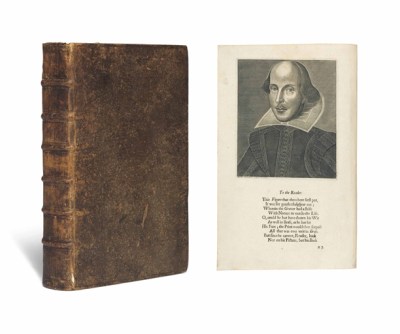
2023 is the four-hundredth anniversary of the publication of Shakespeare’s First Folio, and I can’t believe I forgot to commemorate it. Oh well, it’s December, obviously, so we’re still in the ballpark. Phew.
Anyway, the First Folio was published in 1623, seven years after Shakespeare’s death, by Henry Condell and John Heminge, two friends of the Bard and members of Shakespeare’s own acting troupe. The Folio includes thirty-six of Shakespeare’s plays, as well as a list of the players in his acting troupe and statements that laud the Bard in both poetry and prose by Shakespeare’s contemporaries.
First Folios weren’t cheap, either. According to the Folger Shakespeare Library in Washington, D.C., an unbound First Folio cost fifteen shillings and a bound copy sold for twenty shillings, or a pound. In today’s money that would be around two hundred dollars.
Here are the top three reasons the Folio is significant:
Shakespeare was and still is a hot commodity. Like, really hot.
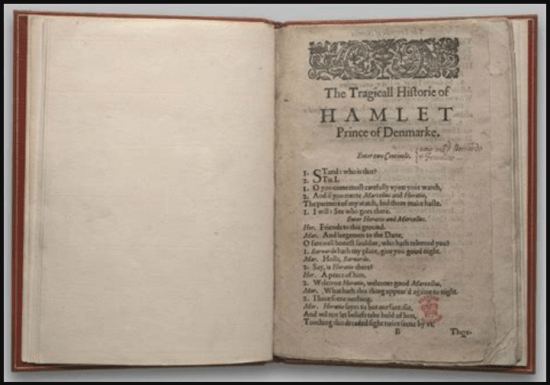
Bootlegging is nothing new, of course, and Shakespeare was so famous during his lifetime that anything with his name on it would sell, even if he had nothing to do with it. Naturally, people wanted a piece of the action, and the best way to do this seemed to be owning a copy of one of his plays.
Some of Shakespeare’s plays were published, but most weren’t and there were unscrupulous types who would take notes during performances and publish what are known as “bad quartos.” These often featured missing or unintelligible dialogue or incorrect stage directions, and unbelievably, some of them survive into the present day (See some samples of bad quarto dialogue here).
The First Folio was not only a tribute to Shakespeare, but aimed to provide a standard of authenticity, thus counteracting the posers and moochers.
It contains a legit portrait of Shakespeare. Well, kinda. His friends and colleagues liked it, anyway.
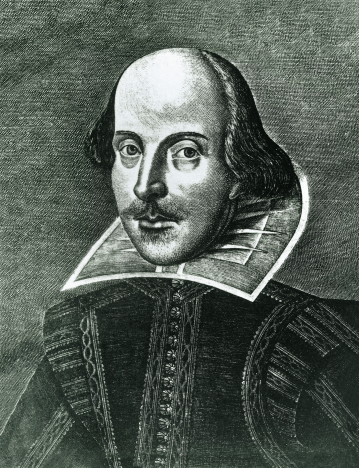
The First Folio obviously carries a ton of historical weight, not the least of which is its inclusion of one of two drawings recognized by Shakespeare’s friends and colleagues to be reflective of what the Bard really looked like.
However, “reflective” doesn’t mean “exact.” The portrait was drawn by Flemish-English engraver and printmaker Martin Droeshout, and has been criticized over the years for its general cartoonishness. Among the various complaints: Shakespeare’s earlobe isn’t realistic, he’s pudding-faced, his face is too long, and so on. To be fair, though, as JSTOR’s Erin Blakemore pointed out, some of this can be blamed on the plate engravers, who may have altered the portrait during production. In fact, this is extremely likely to be the case, as differences have been spotted in the portrait between the First Folio and subsequent Folios.
Then again, Droeshout wasn’t exactly celebrated in his day, at least not when he worked in London, as his engraving of Francisco de la Peña also looks like the Bard. So while we should be thanking the guy for creating a likeness of one of the greatest writers in all of literature, one has to wonder how he got the job in the first place.
Without the First Folio, many of Shakespeare’s plays would be lost.
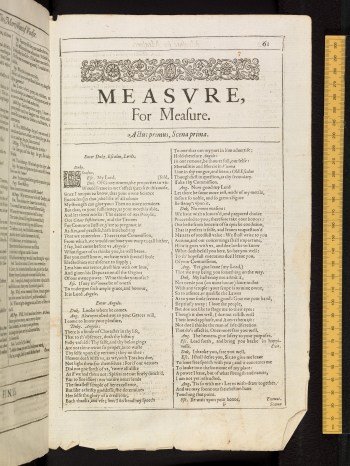
During Shakespeare’s day, plays weren’t treated in the same way as they are today. Actors were given copies of their lines and not the lines of their fellow thespians, and any copies within the company were produced on an on-demand basis. Eighteen of Shakespeare’s plays were published during his lifetime, but eighteen were not, and without the Folio they would have disappeared from English letters.
Now, as I mentioned before, the First Folio was not the only Folio. Subsequent Folios followed in 1632, 1663, and 1684, correcting typesetting errors and other issues in the First Folio, as well as including material left out of that initial volume, but that’s another topic for another time.
So how many of these First Folios still exist? It’s hard to say. Some estimate there are about two hundred left, and others say there are about one hundred-fifty, but the number I prefer to go with is two-hundred thirty-five, which is the count given by both the Folger Shakespeare Library and the Smithsonian, and they also note that previously unknown copies are being discovered to this day. There are people who have dedicated their lives to tracking Folios down, and there’s always a certain excitement around these discoveries, somewhat akin to Indiana Jones finding the Holy Grail.
There’s also an element of time travel to seeing a Folio. Scholars have reported Folios with notes and poems scrawled on pages, and others have found cat paw prints and cigar burns. As You Like It in one Folio is even rebound and reordered, with about a third of the play missing. Shakespearean scholar and University of Nevada, Reno professor Eric Rasmussen said these alterations make this version of As You Like It more like a Samuel Beckett product than Shakespeare. He wishes someone would perform it, but as yet no one’s been willing to take him up on that idea.
I’ve seen two First Folios, one of which was part of a temporary exhibit at the Crocker Art Museum in Sacramento, plus the library at Sierra College had a couple of facsimile editions in their Quarto section, or at least they did at the time I was a student there. For an English major, degree holder, actors, directors, or for that matter, anyone who loves English letters, seeing a First Folio is like a dream. It might not be an original manuscript, but it’s still pretty darned cool.
Our last Shamedown is on its way Friday. As always, thanks for reading, and I hope to see you all then…
The Complete Works of William Shakespeare is available to own from Amazon.
~Purchases made via Amazon Affiliate links found on this site help support Taking Up Room at no extra cost to you.~
If you’re enjoying what you see on Taking Up Room, please subscribe to my Substack page, where you’ll find both free and paid subscriber-only reviews of mostly new and newish movies, documentaries, and shows. I publish every Wednesday and Saturday.
 Taking Up Room
Wow, 400 years–and still around.
LikeLiked by 1 person
Yeah, it’s amazing. 🙂
LikeLiked by 1 person
Here’s to the next 400 years of Shakespeare’s plays and sonnets!
Merry Christmas and Happy New Year, Rebecca.
Maddy
LikeLiked by 1 person
Absolutely yes, and thank you, Maddy! Hope your holidays were great. 🙂
LikeLike