
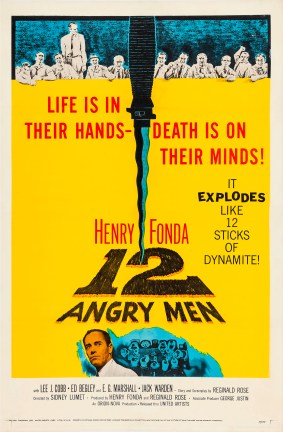
12 Angry Men is one of those stories that has to be seen at least once, whether it’s the play or film, but no matter how many times it’s seen, there’s always something new to notice and something new to think about.
It’s fitting that the story can inspire such perennial freshness. As The Guardian once put it, “Try pitching it to a Hollywood mogul today: 12, mostly middle-aged, men arguing in one room for an entire monochrome film. No women, no sex, no flashbacks, no special effects; the cast relatively unknown except for the ageing star Henry Fonda.”
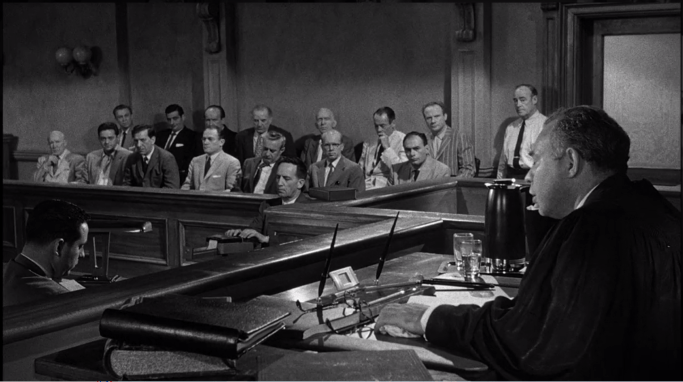
The plot of the film is simply this: A nineteen-year old boy is on trial for murdering his father, an act which was apparently observed by several witnesses. When the jury meets to deliberate the case, it initially appears to be open and shut. There were witnesses, the kid was known to have had a hard life and was abused by his dad, and since he’s poor and one of “those” people, whatever that means, he must have committed the murder because inevitable. He finally snapped after so many hard years and poverty begets crime (It actually doesn’t, but that’s another topic for another time).
The jurors take a preliminary vote, and all but one say the boy is guilty. Juror 8 is the lone voice of dissent.
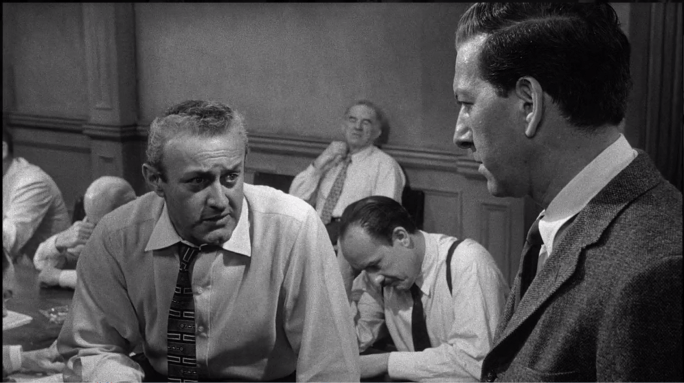
And no, we don’t ever find out any of these characters names. Names are not important in 12 Angry Men because they would distract from the interplay between the twelve jurors. Naturally, this results in us applying our own names to them, because that’s human nature, but in the end, names are neither here nor there. There’s too much to pay attention to.
Also, everyone in the movie is a type without being a type. One juror is a broker and can’t pick up a newspaper without flipping to the stock market report. One’s a baseball fanatic. One’s a quiet fellow who doesn’t volunteer much information. Juror Eight is an architect. Yes, these jurors bring their own mindsets and personal baggage into their decision regardless of bald facts.
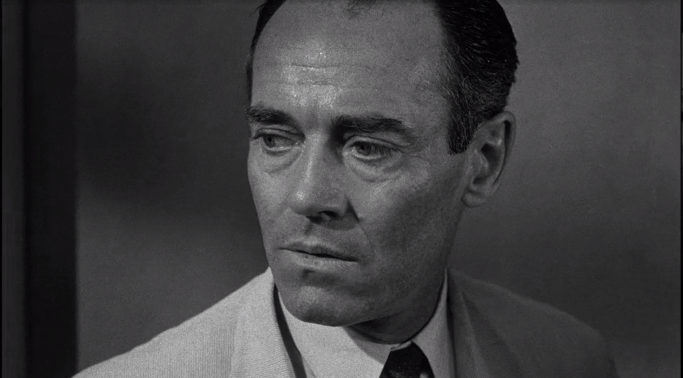
Anyway, at first the remaining eleven jurors set out to convince Number Eight why they’re right and he’s wrong, but as he questions their assumptions and throws doubt on their snap judgements, they gradually start to think and change their minds. True to the title, though, there are a lot of voices raised first, and it all takes place in real time.
Unlike most of the titles in our “Stage To Screen” series, 12 Angry Men didn’t start life as a stage play but as a 1954 teleplay written by Reginald Rose. It’s a half hour shorter than the film, which was directed by Sidney Lumet, but what we know from the film is all there.
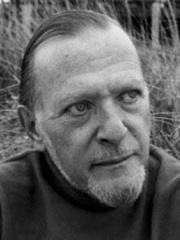
Reginald Rose was born in New York City in 1920. The product of a broken home, Rose was a voracious reader and started writing seriously when he was ten years old, sometimes secretly at night by flashlight underneath the bed covers. After serving in combat in World War Two, he was intent on pursuing a writing career, and television was an up-and-coming field. Rose quickly showed he had a good handle on character and writing true-to-life situations in a very direct and compelling way.
What inspired 12 Angry Men? Plain old simple life, apparently. Rose always held that a jury experience he had in 1954 triggered what became the interplay we know and love. The real trial Rose sat in on was a manslaughter case, and Rose was awed by the gravity of essentially deciding the fate of another person: “It was such an impressive, solemn setting in a great big, wood-paneled courtroom, with a silver-haired judge, it knocked me out. I was overwhelmed. I was on a jury for a manslaughter case, and we got into this terrific, furious, eight-hour argument in the jury room. I was writing one-hour dramas for Studio One then, and I thought, ‘Wow, what a setting for a drama.'”
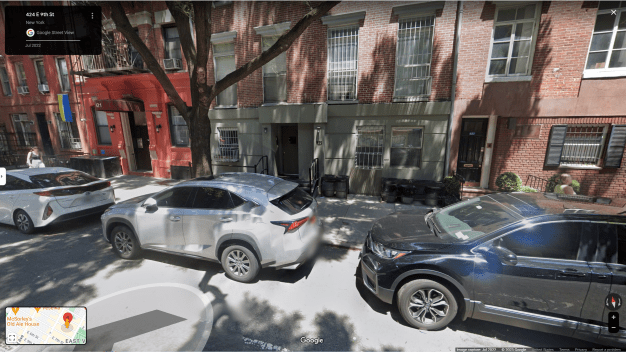
Professor Phil Rosenzweig speculates that the case Rose was referring to is The People vs. William Viragh, which involved an altercation between Viragh, whose nickname was “Lefty,” and a man named Dimitri Mateichik. When Mateichik became drunk and disorderly in a New York bar, he got kicked out, and long story short, he met up with Viragh outside the bar, where the latter stabbed him, whether deliberately or by accident.
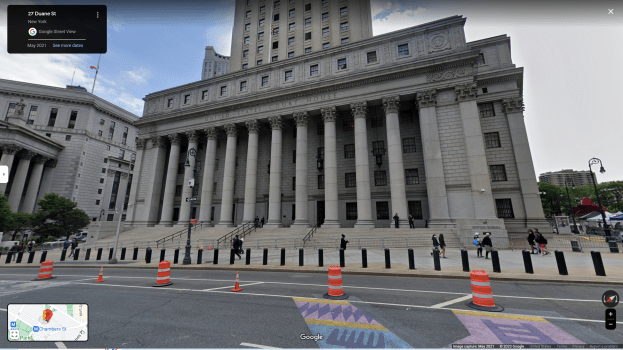
The case was tried at New York’s general sessions court, which is known as Thurgood Marshall U.S. Courthouse today. Viragh was convicted of second-degree assault, although when the judge sentenced him to two-and-a-half years behind bars a month later he also suspended the sentence, which meant Viragh didn’t serve time.
While this is all very interesting, the really intriguing thing about it is that Reginald Rose isn’t listed among the jurors on the case, which was so obscure the papers didn’t even report on it. However, the very likely thing was that Rose was part of the jury pool and heard about the case that way before being eliminated from the selection. He could have also watched the trial from the gallery.
Did Rose ever serve on a jury before he wrote 12 Angry Men? It seems doubtful but who knows. Either way, when Rose submitted his teleplay to his producer, she accepted it right away.
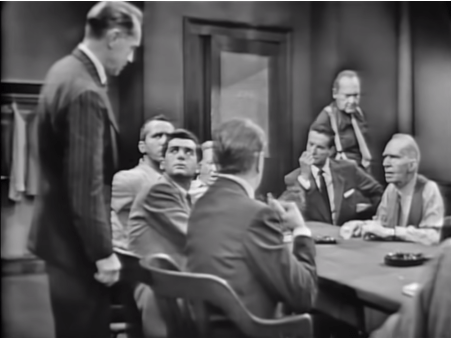
On September 20, 1954, the play premiered on the Studio One series and starred Robert Cummings, Edward Arnold, Franchot Tone, Lee Phillips, Paul Hartman, and George Voskovec. The set was very small and since it was filmed in real time, camera angles and lighting options were limited, which, in the end, increased the dramatic tension.
To say the teleplay made a huge splash is an understatement. Not only did it win an Emmy for Best Television Play, but Rose was immediately asked to write a screenplay of of 12 Angry Men, which was made into a movie directed by Sidney Lumet and released in 1957. Shot in a mere seventeen days, it was Sidney Lumet’s first feature film and Henry Fonda’s first and only producer’s credit. Unlike the teleplay, though, Lumet had some filming options, and as Roger Ebert later wrote, is a “textbook for directors interested in how lens choices affect mood.”
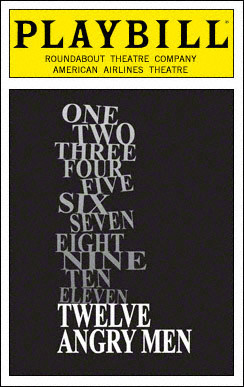
Since 1964 the stage version has been performed all over the world in theaters of various sizes. Incidentally, I first saw 12 Angry Men when I was a high school freshman in 1991. Our drama club did a co-ed version for the fall play, and I remember it being so good that the audience was completely silent for the whole hour and a half.
However, it wasn’t until 2004 that the play came to Broadway, where it ran from October 28th until May 15, 2005 and garnered a Drama Desk Award, a Drama League Award, and an Outer Critics Circle Award, all for Best Revival of A Play. It was also nominated for three Tony Awards. The play is still frequently produced, although in the opinion of some it’s starting to date.
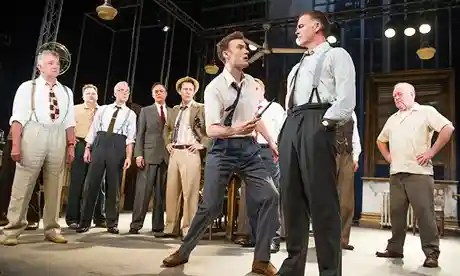
Unfortunately, Reginald Rose wouldn’t live to see 12 Angry Men come to Broadway, having passed away in 2002, but it’s pretty safe to say he would have been highly gratified that a seemingly simple work has had such a long life.
Another review is coming out on Tuesday. Thanks for reading, all, and I hope to see you then…
12 Angry Men is available on DVD and Blu-ray from Amazon. It is also currently streaming on Tubi. The original teleplay can be seen here and the original play is available here.
~Purchases made via Amazon Affiliate links found on this site help support Taking Up Room at no extra cost to you.~
If you’re enjoying what you see on Taking Up Room, please look for additional content on Substack, where you’ll find both free and subscriber-only articles. I publish every Wednesday and Saturday.
Bibliography
Rosenzweig, Phil. Reginald Rose and the Journey of ’12 Angry Men.’ New York City: Fordham University Press, 2021.
 Taking Up Room
So many solid performances in this film, plus a couple of powerhouses. Meaty stuff!
LikeLiked by 1 person
It really is, and it doesn’t date much at all.
LikeLike
Dimitri Mateichik was my Grandfather
LikeLiked by 1 person
Oh wow, that’s cool. He must have been so proud of this movie.
LikeLike