
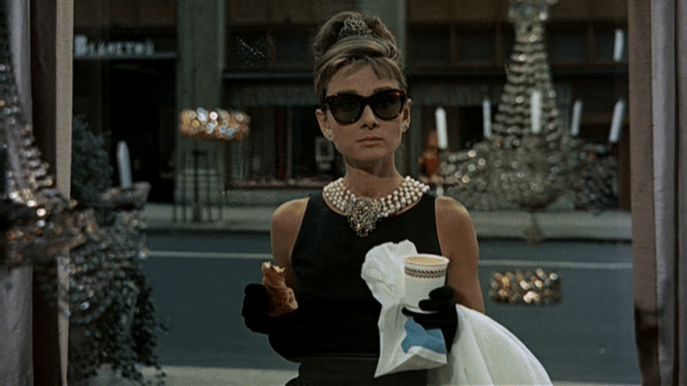
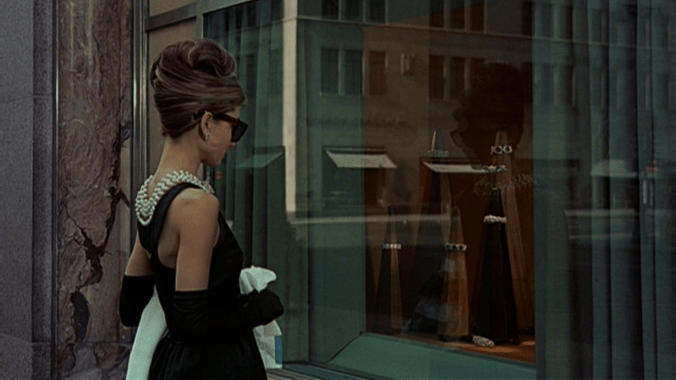
Few movie openings are as iconic as Breakfast At Tiffany’s. Audrey Hepburn as Holly Golightly gets out of a cab in the early morning on Fifth Street in Manhattan dressed to the nines, walks up to a Tiffany’s display window, then pulls a cup of coffee and a croissant out of a paper bag. After staring dreamily at the windows, Holly throws her empty cup and bag away in a trashcan before walking prettily down the empty street.
The 1961 movie is more than familiar, but I’ll sum it up anyway. Writer Paul Varjak (George Peppard) has just moved into an apartment in New York, where he meets the mysterious but intriguing Holly Golightly (Audrey Hepburn). To say this woman is eccentric is an understatement. She lives alone except for her nameless cat, stays out all night, gets paid fifty dollars to go to the powder room, and then when she comes home she forgets her key so she always wakes up her grumpy upstairs neighbor, Mr. Yunioshi (Mickey Rooney).
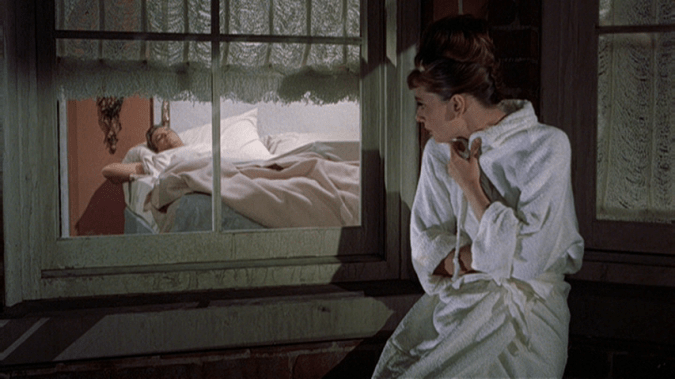
The more Paul sees of Holly the more questions he has, like when he hears her talking in her sleep to her brother, Fred, who’s in the army. Holly hates snoops, but information about her life comes out anyway. She makes a weekly visit to Sing Sing, where she gets the weather report from notorious mob boss, Sally Tomato. She wants more than anything to marry rich so she can buy a ranch for herself and her brother.
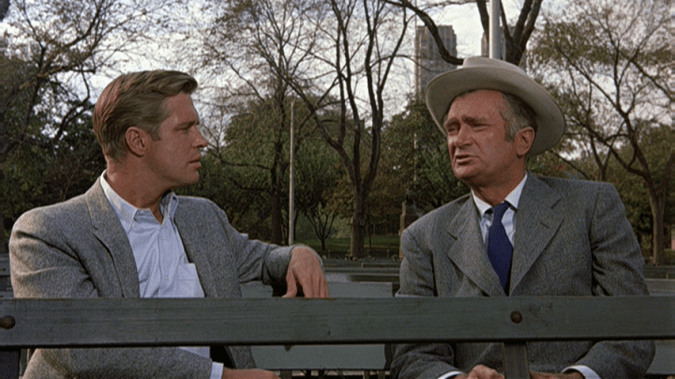
Most mysterious of all is when her estranged husband, Doc Golightly (Buddy Ebsen) shows up, presumably to take her back to Texas with him. He says Holly’s real name is Lula Mae and she married the much older widower Doc when she was going on fourteen. Holly says Doc is in denial about their marriage being annulled and that no one should love a wild thing like her.
All of Holly’s chickens come home to roost in some way, and she’ll have to decide whether she wants to deal with them or run again.
It goes without saying that Audrey Hepburn is loved. The black dress she wears in several scenes of the movie is loved. Tiffany’s is loved. The trademark Blake Edwards quirk is loved. Mickey Rooney as Mr. Yunioshi is not exactly loved. But we’ll get to all that.
Author Truman Capote was born Truman Streckfus Persons on September 30, 1924 in New Orleans. After his parents divorced when he was very young he was shuffled from elderly relative to elderly relative in Alabama, even meeting one Harper Lee in Monroeville. The two of them would remain friends for decades and Capote would serve as the inspiration for Dill in To Kill A Mockingbird.
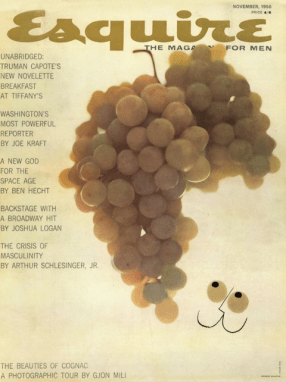
Following graduation from Greenwich High School in Millbrook, Connecticut, Capote set his sights on writing. His first story, “Miriam,” was published in Glamour in 1945. His works were not only slightly autobiographical, but misfits were a common sight, and Holly Golightly was no different. Breakfast At Tiffany’s was originally published in Esquire Magazine in 1958 and later reissued as a novella.
The obvious question is: Who was Capote’s inspiration for his Breakfast At Tiffany’s heroine? The not-so-obvious answer is: Depends on who’s asked. Numerous women have claimed to be the real-life Holly Golightly, among them hostess Marguerite Littman, who, as a younger woman tried to make it as an actress in Hollywood, but her thick Louisiana accent held her back, so she became an accent coach. Other possibilities were supermodel Dorian Leigh, Leigh’s sister Suzy Parker, Capote’s German neighbor and a beautiful woman from Montana who had no great talents but who was six-foot-two.
When the story became a success, naturally Hollywood came calling, and everyone had their own ideas about what a film of Breakfast At Tiffany’s should look like.
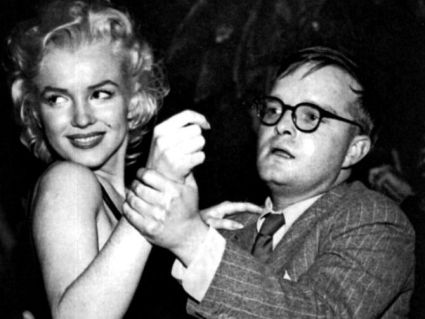
I know Capote had Marilyn Monroe in mind for the movie Holly Golightly, but to be honest, I see Holly in her raw form as more of a Jayne Mansfield type–a little coarser, a little brassier, but just as showy in the looks department.
As we all know, though, Audrey Hepburn got the part and was able to make her own Holly. While she more than brought the quirky, fun elements, she wasn’t a call girl type, at least outwardly. While this might seem to santize the character, it also leaves the audience to wonder what happens to Holly offscreen, an effective device for a story with potentially controversial subject matter. For one thing, the novella’s Holly opines about how every woman is a lesbian, at least a little bit.
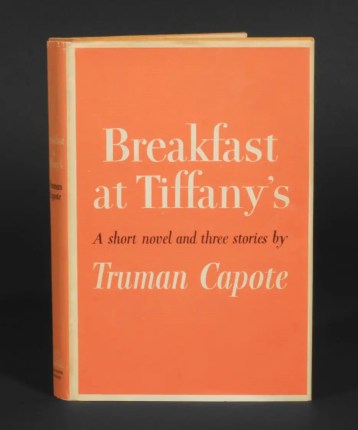
The film took plenty of liberties with the novella, which was set during the Second World War, and not only pushed it forward about twenty years but made Holly a real presence. In the novella, Paul speculates with various people who knew Holly about her whereabouts, but his place in Holly’s world is largely ambiguous and all her scenes are told in flashbacks.
In the movie, Paul is both a writer and a kept man, with rich socialite Mrs. Failenson (Patricia Neal) turning his apartment into a gaudy mausoleum of a dwelling and paying him for services rendered.

The endings of the novella and the film couldn’t be more different, with the film obviously wanting Holly to redeem herself and not be a wild thing anymore. There’s also a scene in a strip club that’s not in the novella, although Holly does sunbathe in the nude, so skin is a thing either way.
Other than that, the film is familiar territory, with a lot of dialogue and scenes lifted almost verbatim from the original novella, including an interlude that shows Holly’s dreamy, wistful nature:
On days when the sun was strong, she would wash her hair and, together with the cat, a red tiger-striped tom, sit on the fire escape thumbing a guitar while her hair dried. Whenever I heard the music, I would go stand quietly by my window. She played very well, and sometimes sang too…there were moments when she played songs that made you wonder where she learned them, where indeed she came from. Harsh-tender wandering tunes with words that smacked of piny woods or prairie. One went: Don’t wanna sleep, Don’t wanna die, Just wanna go a-travelin’ through the pastures of the sky; and this one seemed to gratify her the most, for often she continued it long after her hair had dried, after the sun had gone and there were lighted windows in the dusk.
This, of course, translated into the song, “Moon River,” brilliantly written by Henry Mancini and Johnny Mercer and gorgeously played by Audrey Hepburn, who did her own singing:
Amazingly enough, the song was very nearly cut from the film because the preview screening was too long, but legend has it Audrey herself leapt to her feet and said, “Over my dead body,” when she was told of the song possibly getting the axe.
What was never on the chopping block was Audrey’s famous black dress, of which there were three. One, a shorter version that wasn’t used in the film. is in the Givenchy archives. The second dress was modeled by Natalie Portman for Harper’s Bazaar and recently auctioned by Christie’s for roughly $650,000. The third, which was a copy of the second, resides at the Garment Museum in Madrid. The design of all three dresses hearken back to Coco Chanel, who was the pioneer of the Little Black Dress in the 1920s.

And what of no one’s favorite, Mickey Rooney as Mr. Yunioshi? Anyone who’s seen the film at least once knows that this is probably one of the biggest miscastings in film history. If the role wasn’t full of broad stereotypes, Phillip Ahn or Keye Luke would have been so much better.
So why, after all that, was Rooney cast as the hot-tempered lensman? Comedy. Rooney later said, “Blake Edwards, who directed the picture, wanted me to do it because he was a comedy director. They hired me to do this overboard, and we had fun doing it. Those that didn’t like it, I forgive them and God bless America. God bless the universe, God bless Japanese, Chinese, Indians, all of them and let’s have peace.”

Er, the audience isn’t the problem, Mr. Rooney, but OK.
While Mr. Yunioshi hasn’t aged well, Breakfast At Tiffany’s is a beloved cultural benchmark because it is, as Holly Golightly said, a “wild thing,” Audrey Hepburn is wonderful, and when we stare at those glamorous Tiffany windows, we may find ourselves dreaming.
The SIxth Broadway Bound Blogathon is coming up on Friday. Thanks for reading, all, and I hope you’ll join us. Have a good one…
Breakfast At Tiffany’s is available on DVD and Blu-ray from Amazon. The original novel is also available.
~Purchases made via Amazon Affiliate links found on this site help support Taking Up Room at no extra cost to you.~
If you’re enjoying what you see on Taking Up Room, please look for additional content on Substack, where you’ll find both free and subscriber-only articles. I publish every Wednesday and Saturday.
 Taking Up Room
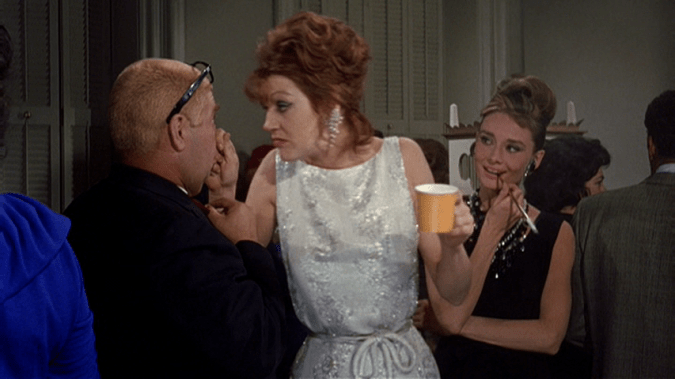
Breakfast at Tiffany’s is a film that’s grown on me over the years. When I first saw it in high school, I didn’t get what was so great about it and I think a lot of the more adult material flew right over my head. I saw it again a few years ago and fell in love with it. A lot of praise goes towards Hepburn and she is fabulous in what truly is an atypical role for her (which makes it all the more ironic that this is her signature performance), but it is Blake Edwards’ direction that always stands out most for me. Edwards was super inspired by silent film comedy and you can see that even in his less slapsticky offerings, like BAT. The party scene in this feels like a warm-up for Edwards’ The Party (1968), with its constant sight gags and eccentric characters.
LikeLiked by 1 person
That’s a really good point–he seemed to enjoy those party scenes. And I’m right there with you. High schoolers aren’t the target audience, I guess.
LikeLike