
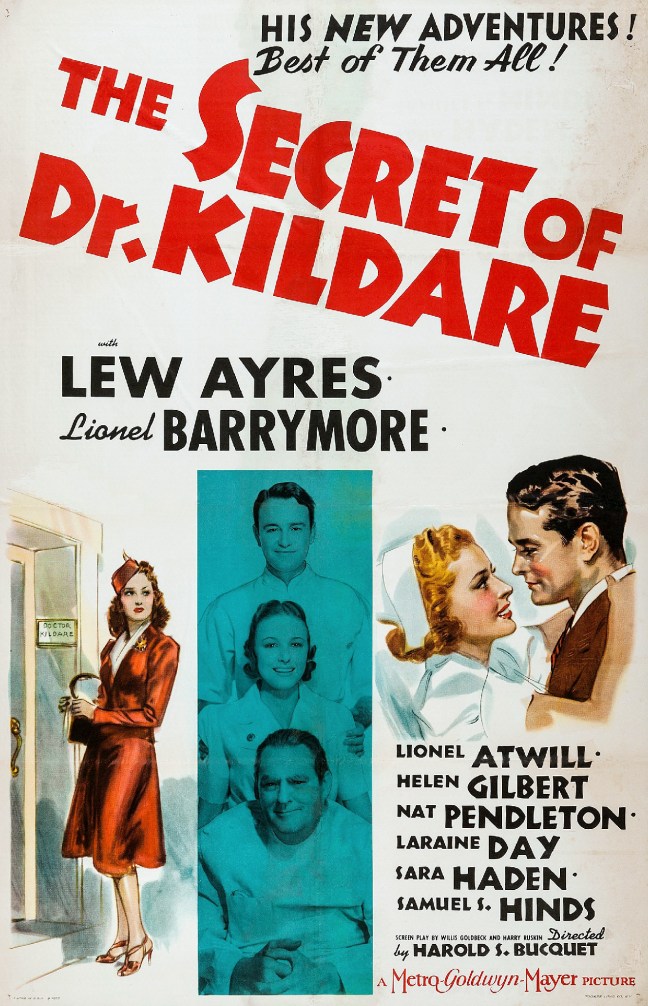
One of the most highly successful series of the mid-thirties and early forties was Dr. Kildare, which paired a young Lew Ayres with an older Lionel Barrymore. The clash of generations and an older doctor mentoring a younger one never failed to land. The third movie in the series was 1939’s The Secret of Dr. Kildare, in which delicacy is the order of the day.
The movie opens at the Blair General Hospital, where Dr. Leonard Gillespie (Lionel Barrymore) is seeing patients and secretly fuming because he thinks his assistant, Dr. James “Jimmy” Kildare (Lew Ayres) is late. After counseling a scared mother-to-be about her pregnancy, Leonard nods off in between fuming. He changes his mind, though, when Jimmy walks in and tells him he’s been working all night.
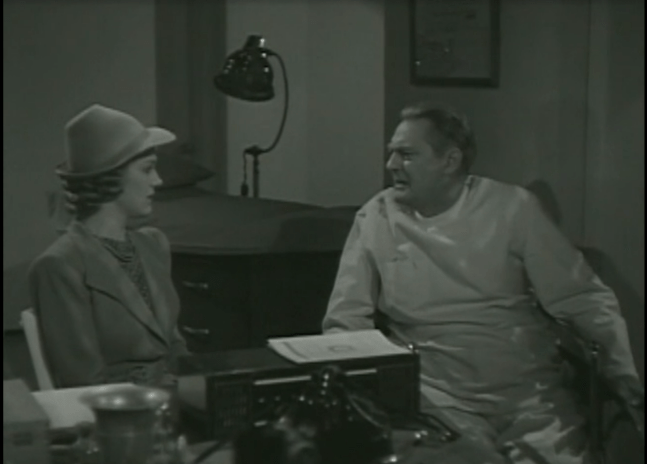
Leonard and Jimmy have a pretty prestigious patient coming to see them, well, he’s not a patient but a concerned father, Paul Messenger (Lionel Atwill) coming on behalf of his daughter, Nancy (Helen Gilbert), who’s been acting strangely. She goes between staying out until all hours to sleeping and overall being very secretive. She also runs very hot and cold and Dad is concerned.
The young Kildare agrees to take the case and pretend he’s just a friend of Paul’s so that Nancy doesn’t suspect she’s being evaluated. The first thing to do is go to the Messenger house and meet Nancy, but on the way Jimmy has a brief tete-a-tete with his girlfriend, Nurse Mary Lamont (Laraine Day), who’s a little mystified and suspicious about Jimmy’s new assignment, but also pretty understanding.
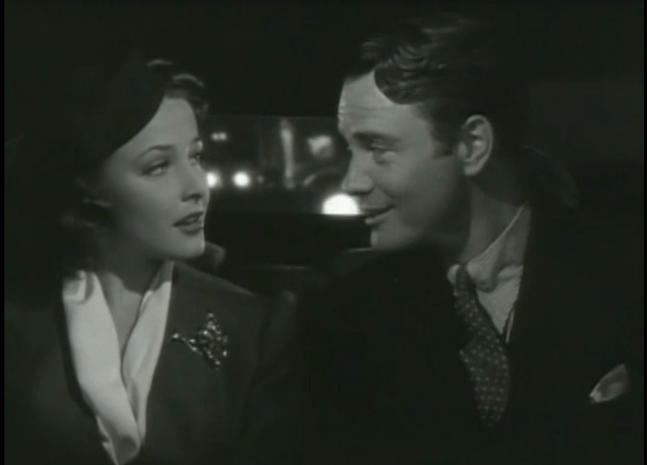
Jimmy and Nancy hang out all night and watch the sun rise, which Jimmy feels is good progress. He keeps coming back to the Messenger house, spending time with Nancy and filling Paul in about whether or not Nancy has given him any clues about her condition. Jimmy even asks to take the case officially, which Leonard takes personally, but on the other hand, it forces him to rest and relax.
Our hero gets close enough to Nancy that when she gets a call from Nora (Sara Haden), the housekeeper at the Messenger house in Long Island, Jimmy drives out there with her. There, Nancy has a splitting headache and Nora tells Jimmy that Nancy has a brain tumor.
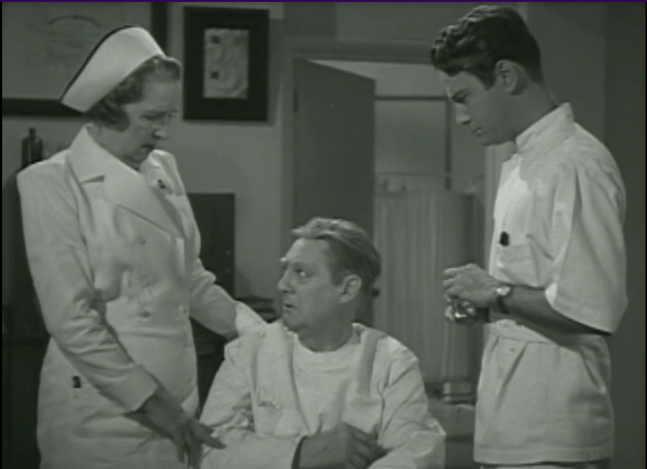
Things get even more intriguing when Jimmy goes with Nancy and Nora to see a nature healer named John Xerxes Archley (Grant Mitchell), a guy who presents himself as a doctor but who comes off as a quack in every way. Unfortunately, Archley figures out pretty quickly that Jimmy is a doctor, but it just so happens that Jimmy has a few tricks of his own up his sleeve, and Dr. Gillespie.
And no, I’m not going to spoil anything. Put it this way: There is nothing new under the sun.
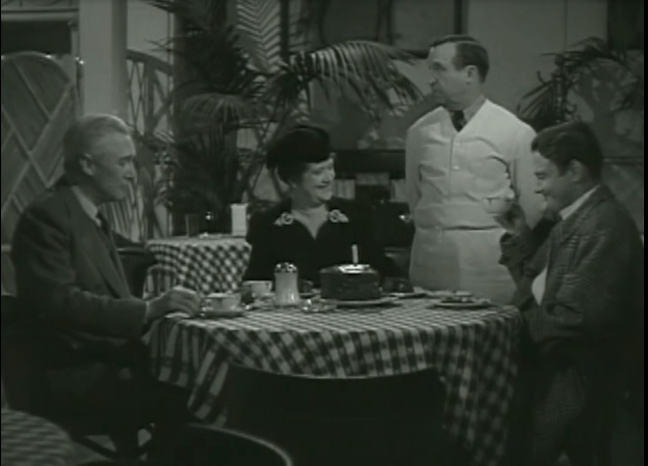
This movie is pleasant all the way through and keeps the atmosphere fairly light, considering the heavy issues it touches on, such as quack doctors and cancer, but the movie never really goes deeply into any of them and instead focuses on the relationships between the characters. Lew Ayres and Lionel Barrymore play off each other wonderfully, the latter from a wheelchair. Barrymore’s chronic pain is more than evident all over his face in this movie, as is his exhaustion, but it didn’t stop him from going all out in his usual fashion.
Dr. Kildare started life as a pulp fiction character developed by Frederick Faust, who wrote under the pen name of Max Brand. Faust based James Kildare on his real-life college friend, Dr. George Winthrop Fish, who became a surgeon in New York. Kildare’s first appearance was in the short story, “Internes Can’t Take Money,” which was published in Cosmopolitan in 1936, followed by more short stories, and the first Dr. Kildare novel, Calling Dr. Kildare, was published in 1940.
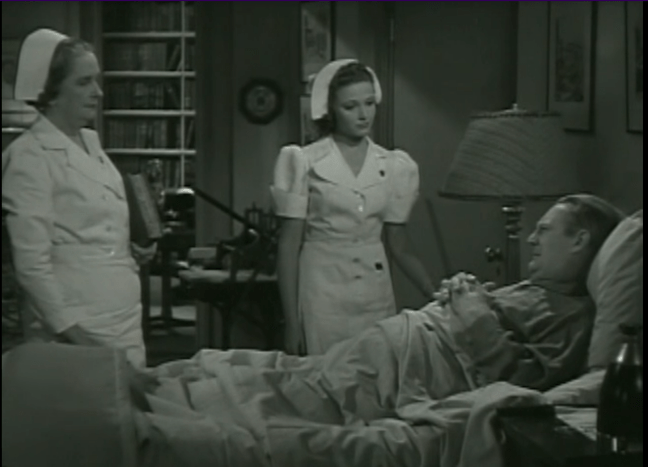
As with any hot property, Hollywood came sniffing around, and the Dr. Kildare series started at Paramount, with 1937’s Internes Can’t Take Money, starring Joel McCrea and Barbara Stanwyck. And in case anyone is wondering, yes, “interns” was spelled with an extra “E” back then. It messes with the head, but what can we do? Oh well.
Despite a tepid audience response, MGM still saw potential for the character on the big screen, so they bought the rights and released their own Dr. Kildare movie, Young Dr. Kildare in 1938, starring Lew Ayres and Lionel Barrymore.

According to TCM, the series was initially considered B-grade and intended to piggyback off of the popularity of the Andy Hardy series, but Ayres and Barrymore worked so well together that more movies were planned. Barrymore had great respect for Ayres and compared working with him to acting opposite Spencer Tracy.
Secret did respectably well in the crowded year that was 1939, pulling in roughly $42M in today’s money, although it was beaten out by its predecessor, Calling Dr. Kildare, which also came out in 1939 and made about $95M.
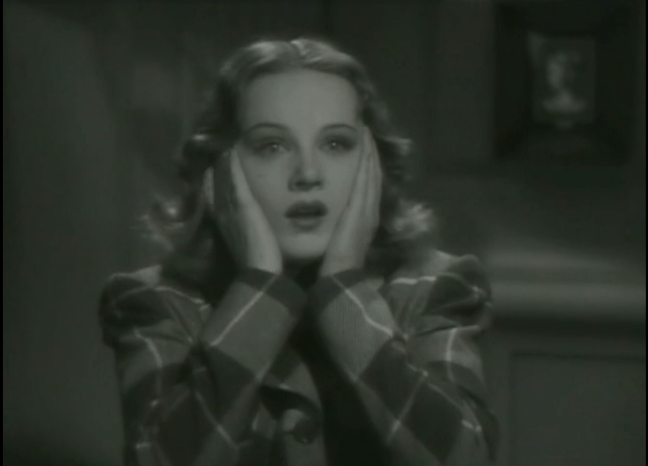
The critics had plenty to say, of course, and although they weren’t exactly gushy, they were invariably favorable. Mostly, anyway. Motion Picture Herald said the film had “universal audience appeal, with no frills.”
FilmIndia, however, was more restrained: “It is as usual well-produced, but the story this time is rather weak in incidents. It is however a chaste entertainment and quite a good thing to see.”

Motion Picture Daily opined, “This is the kind of picture that keeps the industry in the forefront of entertainment forms. It has recognition value to the customer in its players and in that it is the third of a series ; it has a well defined story outline, and it has pace and action.”
Showman’s Trade Review agreed: “Amusing and human, it is swell entertainment and should find an ever-increasing audience wherever it is played. The Lionel Barrymore-Lew Ayres combination is perfect and they work together flawlessly, giving smooth and convincing performances.”

The Movies…And People Who Make Them, on the other hand, was downright clinical:
“The formula for the Dr. Kildare pictures, of which The Secret of Dr. Kildare is a sleek and patterned third, is no secret. You take an earnest young doctor, an eminent medico who preaches devotion to science and medical progress and is a lovable old codger under all that crustiness and surgical gauze — – and of course a pretty nurse. For the rest take a lot of formidable looking gadgets, a breathlessly medical vocabulary for the doctors all, and a lot of patients who can be terrified, quizzical, “funny,” or just plain patient under diagnosis and treatment.”
Sadly, the Dr. Kildare formula, at least the one containing Max Brand, Lew Ayres and Lionel Barrymore, was short-lived. MGM ended its partnership with Brand in 1941, and when the Second World War came, Lew Ayres declared himself to be a conscientious objector. This not only turned the public against him, but Ayres lost his MGM contract.


Ironically and fittingly, Ayres, after a brief stint in a conscientious objectors’ camp in Oregon, signed on as a medic for the Army, where he served with distinction in the Pacific. The Dr. Kildare series carried on without him, but neither it nor Ayres’ career were ever the same again. They did, however, lay the groundwork for a Dr. Kildare TV series as well as the medical dramas that have graced the airways in the decades since.
September is upon us–hard to believe, isn’t it? We don’t have any blogathons next month, but it’s still going to be busy. Speaking of which, another Substack update is coming up on Thursday. Have a good one, all, and I hope to see you then…
The Secret of Dr. Kildare is available on DVD from Amazon. It is also available to stream on Tubi.
~Purchases made via Amazon Affiliate links found on this site help support Taking Up Room at no extra cost to you.~
If you’re enjoying what you see on Taking Up Room, please subscribe to my Substack page, where you’ll find both free and paid subscriber-only reviews of mostly new and newish movies, documentaries, and shows. I publish every Wednesday and Saturday. You can also subscribe to my Club 15 Tier, which gives you at least one extra Taking Up Room post every month for a small fee.
 Taking Up Room