
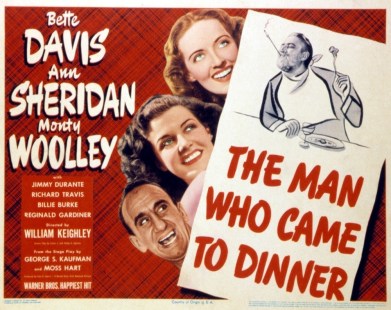
Kaufman and Hart definitely weren’t one-hit wonders. In addition to You Can’t Take It With You and several other hits, they also co-authored The Man Who Came To Dinner, which came to Broadway in 1939 and then the silver screen in 1942.
Oh, this crazy thing. Among other niceties, Billie Burke is again playing a rich socialite who is expecting an important guest to dinner, only in this case her guest won’t be going home for a very long time.

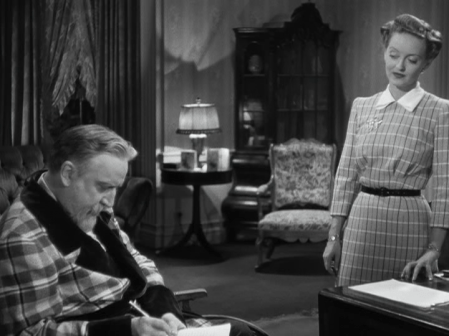
For clarity’s sake, we’ll start with what’s in the movie. Sheridan Whiteside (Monty Woolley) is to have dinner at the home of Mr. and Mrs. Ernest and Daisy Stanley (Grant Mitchell and Billie Burke) in Mesalia, Ohio. He’s a radio personality on the line of Alexander Woollcott and snobby to a fault, only he mildly tolerates the Stanleys because the dinner is a publicity stunt.
Unfortunately for everyone, the Stanleys’ distinguished guest slips on the icy stairs and falls heels over head to the sidewalk, fracturing his hip. There’s a big to-do, of course, because Mr. Whiteside isn’t an easy house-guest. Insults come easily to him and he doesn’t seem to like anyone except for himself. He takes over the Stanley abode. Ernest and Daisy have to use the back stairs. They can’t use their own dining room because “Sherry” wants it for his guests, he wants to be in charge of the menus, and he has a wild assortment of people and animals in and out all the time.
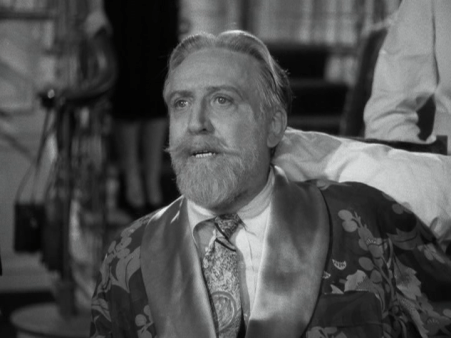
Mostly in, though. Anyone from dignitaries to entertainers to socialites to parolled convicts on a break from their work detail all make appearances at one time or another. Sherry also brings in his pet octopus and four penguins, all of which are installed in the study, where His Lordship rests when he isn’t holding court in the living room. They’re a source of unbridled horror and worry for Dr. Bradley (George Barbier) and the frazzled nurse looking after Sherry, Miss Preen (Mary Wickes), who’s driven so crazy by Sherry’s various foibles that she begins to think she’s seeing things, such as a penguin with a thermometer in its mouth.
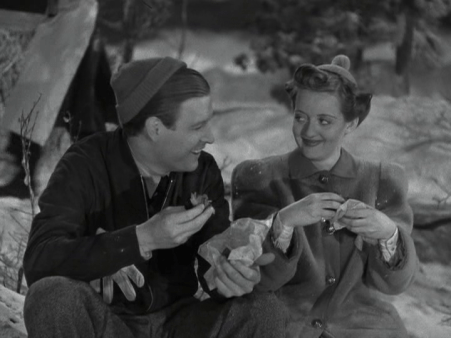
Sherry might be coddled and catered to by everyone around him, but the one person who isn’t impressed is Maggie (Bette Davis), his assistant. Maggie’s been with Sherry for ten years, knows all his tricks and isn’t afraid of him in the slightest, but she puts up with him because deep down she likes him at least on some level. While in Mesalia, though, Maggie meets and falls in love with Bert Jefferson (Richard Travis) a newspaperman who’s written a play and wants Sherry to read it.
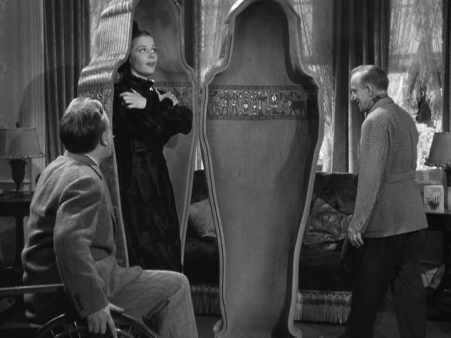
The intrigue runs thick here, as Sherry tells the two adult Stanley children, June (Elizabeth Fraser) and Richard (Russell Arms) to follow their hearts. Who cares that Daisy and Ernest don’t want June marrying her conniving union leader boyfriend and Richard running off to South America to be a photographer? Sherry’s doing a good deed, after all. He’s not above matching Maggie prank for prank, either, especially when his friend, Mrs. Sheldon (Ann Sheridan) comes to visit and per Sherry’s direction, casts her eye at Bert.
It all gets crazier and crazier, until the longsuffering Ernest demands Sherry leave or pay the consequences. Oh, and one of Sherry’s penguins bites poor Miss Preen during Sherry’s Christmas broadcast from the Stanley living room.
Yipe. What in the world inspired Kaufman and Hart to write this nutty play? Plain and simple life. Sheridan Whiteside was modeled after Alexander Woollcott, based on a visit Woollcott made to Moss Hart’s house, in which he showed up unannounced, took over the master bedroom, demanded chocolate chip cookies and a milkshake at bedtime, was a jerk to Hart’s staff and generally obnoxious to everyone else, and then he had the nerve to write about how unpleasant his visit was in Hart’s guestbook.
Hart was annoyed at the time but laughed over it later with Kaufman, noting with grateful horror that it was a good thing Woollcott hadn’t broken his leg or something and been unable to go home. And with that, an idea was born.
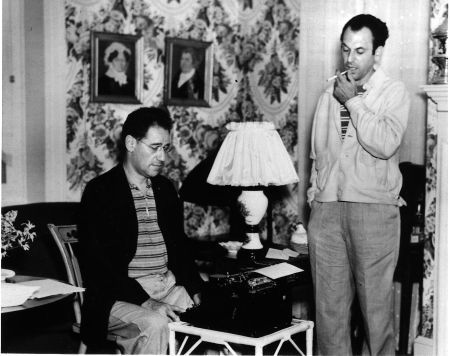
The play ran from October 16, 1939 until July 12, 1941 at the Music Box Theater, starring Monty Woolley as the original Sheridan Whiteside. There was plenty of buzz around the play, especially after Bette Davis saw it and wanted to play Maggie in a film version. Since Woolley was primarily a stage actor and not terribly well-known, several others were considered for Whiteside, including John Barrymore, Orson Welles, Fredric March, and Charles Laughton, but in the end Woolley would reprise his role for the screen. It was also the film debut of one Mary Wickes, who had played Miss Preen on Broadway and who would go on to a long and respected film career.
Julius and Philip Epstein wrote the screenplay, leaving Kaufman and Hart’s original story mostly intact, albeit stretching it out a wee bit, as the play opens with Sherry already established in the Stanley living room and Burt coming around asking about his play. It’s probably a good thing the Epsteins tweaked the opening, because the proceedings may have felt a little too top-heavy otherwise.

The Man Who Came To Dinner had to compete against numerous 1942 heavyweights at the box office, but still pulled in a healthy $150M in today’s money. As for the play, while the film was being made, the play was making a splash in London with Robert Morley as Sheridan. It’s since been revived in 1980, starring Ellis Rabb and then in 2000 starring Nathan Lane.
While The Man Who Came To DInner is hilarious, the jokes don’t always land the way they should, maybe because so many of the pop culture references are firmly rooted in the 1930s, which might be a bit unfamiliar for some nowadays.
Personally, I don’t know if it’s my favorite of Kaufman and Hart’s plays. Sheridan is a mean old cuss whose unbridled snark doesn’t wear well, he doesn’t get much comeuppance, and although Sherry eventually does exhibit some good qualities, Dinner is not as fun as You Can’t Take It With You or my other favorite, George Washington Slept Here. Still, it gets the wheels in my head turning and that’s never a bad thing.
This is the last installment in the Stage to Screen series, and for that matter, the Page To Screen series. I know I said I would end these series later, but an idea came to me that was too tempting to put off. It’ll start on February eleventh, which I know seems sort of random, but it will make sense when I tell you all why. All right, thanks for reading, and I hope to see you tomorrow for December’s Substack recap…
The Man Who Came To Dinner is available to own on DVD from Amazon. The original play can be found here in book form and the film of the Nathan Lane revival (DVD).
~Purchases made via Amazon Affiliate links found on this site help support Taking Up Room at no extra cost to you.~
If you’re enjoying what you see on Taking Up Room, please look for additional content on Substack, where you’ll find both free and subscriber-only articles. I publish every Wednesday and Saturday.
 Taking Up Room