
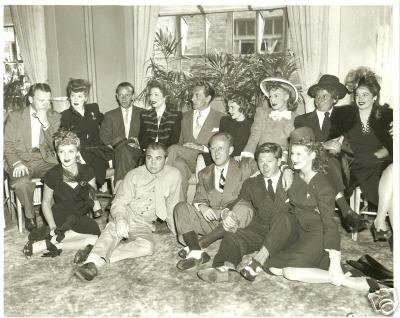
Hollywood’s involvement in the war effort went beyond movies, canteens, and bond tours. There were also quite a few shorts produced by Hollywood stars and studios because, to paraphrase something Frank Capra once said, films are excellent teaching tools.
Americans were told all the time to buy war bonds, to be careful of what they said, and to not give up the fight, but when a message is delivered in various ways over and over, the average person tends to tune out eventually. A film might be just the thing to jolt someone out of complacency, an especially important tool in a time when America’s future was tenuous and there were reasons to dread what might happen.
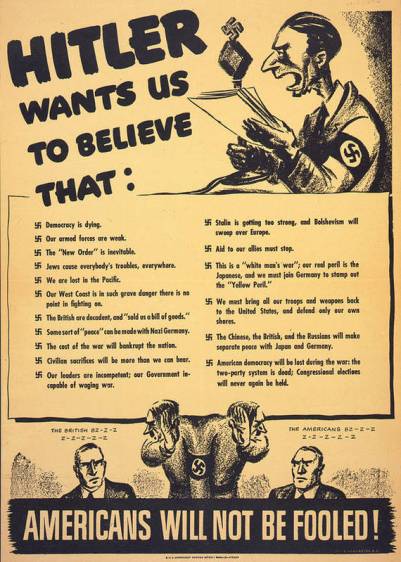
Dozens of short films were made promoting the war effort. Most of them were animated, but more than a few were live action, some featuring actual footage of soldiers overseas and at home and others that were mini docudramas. Today we’re going to look at thirteen of these films, and while some faces will appear more than others, there’s a pretty good variety.
To begin, this 1941 short, Safeguarding Military Information stars Walter Huston and Eddie Bracken and was directed by Preston Sturges. It was geared toward both military personnel and war workers, who had a delicate balance to maintain. After all, loose lips might sink ships. Or blow up trains. Or make the Allies lose the war:
Soon after the United States entered the war, Lieutenant James Stewart filmed the 1942 short, Fellow Americans, which was meant to help raise support for the fight and was directed by Garson Kanin:
Here’s an unusual stop animation short also from 1942: George Pal’s Tulips Shall Grow. Starring Victor Jory and Rex Ingram, it’s the story of Dutch children who encounter invading Nazi soldiers, only they’re referred to as “The Screwballs.” There’s not a lot of dialogue, but the obvious message is, “Hang in there. We’ll get through this, we’ll be happy again, and life will be beautiful.”
Some shorts, like this 1942 bond pitch from James Cagney, were very simple and straightforward:
This wasn’t Cagney’s only war bond sell job. Here’s another short from 1942 in which Cagney and Edward Arnold go back and forth about the importance of buying war bonds. Well, it’s mostly Cagney, but Arnold provides a listening ear:
Cagney was a busy guy in the shorts department, and here he is yet again with Ann Sothern, and Margaret O’Brien in the 1943 film, “You, John Jones,” which asked Americans to imagine themselves in the shoes of those living in other countries. According to TCM, James Cagney came over to MGM specially to make this short:
Also busy was Ronald Reagan, who narrated 1942’s Beyond the Line of Duty, which followed the story of Lieutenant General Hewitt T. Wheless, a highly decorated Army Air Force Pilot who was mentioned by President Roosevelt in a Fireside Chat after one memorable mission:
Reagan also lent his talents to the 1943 film, Recognition of the Japanese Zero Fighter, which was, no doubt, classified information during the war and probably for some time afterwards (Pay no attention to the thumbnail; the video does actually work):
Another 1943 short was Food And Magic, starring Jack Carson, Fred Kelsey, Marjorie Horshelle and Faye Emerson, which encouraged rationing:
Besides the fun of watching Jack Carson pretend to be a magician, the film’s very obvious message was that rationing and price controls had a purpose, and that the average American needed to place the war first by being careful with their food.
Wartime shorts did get a little bit crazy. Here are the Three Stooges in the 1943 film, Dizzy Pilots. Odds are excellent wartime audiences were thankful these bums would never pilot an actual plane. I’m not a fan of the Stooges, like, at all, but the mood of this little gallery has to be lightened up somehow:
On a much more serious note, 1944’s A Letter From Bataan reminded the folks at home that there was not only still a fight to be won, but that hoarding and reckless spending harmed the war effort. Among other tasks, Americans needed to conserve materials such as rubber and steel and save kitchen fats:
Later in the fight, people started looking forward to the years ahead. 1944’s Skirmish On the Home Front starred Betty Hutton, Alan Ladd, Susan Hayward and William Bendix, and put forth the very sound idea that good things come to those who wait, such as futuristic houses with glass refrigerators and furnaces that could be banked just by touching what appear to be window blinds. Meanwhile, those who cashed in their bonds early would have nothing but regrets:
Guilt is sometimes a cheap tactic, but seeing as over eighty-five million Americans bought almost two billion dollars worth of bonds and war bond pleas were literally everywhere, a lot of people were definitely listening.
Bonds weren’t the only cause Americans were asked to contribute to, and we’re going to wind up with Humphery Bogart in the 1944 short, Report From the Home Front, which showed Americans where their Red Cross contributions were being spent, featuring footage of soldiers at Red Cross facilities enjoying ham and eggs and dancing with pretty girls. Keen-eyed film lovers have noticed Bogie’s outfit is very similar to the one he wore in the final scene of Casablanca.
Watching these shorts today can, on the surface, seem like reading someone else’s mail, but they also serve as reminders of how to win a war. Americans rose to the challenge of fighting both on the battlefield and at home, and the results speak for themselves.
Another post is coming up tomorrow. Thanks for reading, all…
If you’re enjoying what you see on Taking Up Room, please look for additional content on Substack, where you’ll find both free and subscriber-only articles. I publish every Wednesday and Saturday.
 Taking Up Room